
Position-specific football conditioning means tailoring your physical work so defenders, midfielders and forwards develop the specific speed, endurance and strength they need for match demands. Use a clear plan de entrenamiento físico por posiciones en fútbol, progress load gradually, and adjust sessions based on fatigue, pain signals and competitive calendar for safer performance gains.
Primary performance goals by position
- Defenders: repeated accelerations over short distances, aerial and dueling strength, lateral shuffling, fast recovery after sprints.
- Central midfielders: high aerobic capacity, repeated high-intensity efforts, agility to turn under pressure, trunk stability.
- Wide midfielders: repeated long runs along the flank, speed endurance, rapid decelerations and changes of direction.
- Forwards and wingers: explosive first steps, maximal sprint speed, short-space agility and shooting under fatigue.
- All positions: robust hamstrings, hips and core, good landing mechanics and sprint technique to reduce injury risk.
Position-specific conditioning: defenders
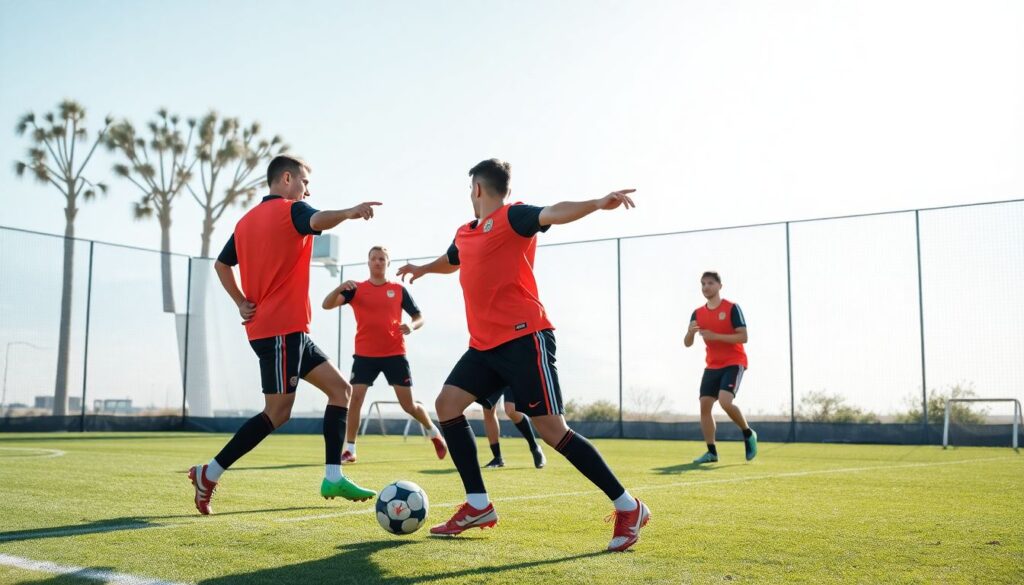
This section is ideal if you are designing rutinas de entrenamiento para defensas de fútbol at amateur to semi‑pro level in Spain. It fits players with basic strength training experience and access to a pitch two to four times per week.
Avoid aggressive progressions if the player has recent hamstring, groin or knee injuries, has not trained regularly in the last month, or shows red flags like sharp pain, dizziness, chest discomfort or feeling "heavy" and unusually breathless in warm‑up.
- Core physical targets for defenders
- Short sprint acceleration (5-15 m) to close down attackers.
- Lateral and backward movements with quick changes of direction.
- Duelling strength for shoulder‑to‑shoulder, holds and aerial battles.
- Sample physical block for defenders (2 times per week)
- Acceleration sprints: 6-10 x 10-20 m from varied starts (forward, lateral, backpedal to turn).
- Lateral shuffle pattern: 4-6 x 20-30 s across a 10-15 m zone.
- Strength: 3-4 exercises focusing on posterior chain, hips and upper body.
- Scalable variations per defender workout
- Conservative: 4 x 10 m sprints, 3 x 20 s shuffles, 2 sets per strength exercise.
- Intermediate: 6-8 x 15-20 m sprints, 4-5 x 25 s shuffles, 3 sets per strength exercise.
- Harder: 8-10 x 20 m sprints with direction change, 5-6 x 30 s shuttles, 3-4 sets per strength exercise.
- Key strength exercises for defenders
- Lower body: split squats, hip thrusts, Romanian deadlifts, lateral lunges.
- Upper body: rows, push‑ups, resisted holds in split stance (simulate duels).
- Core: anti‑rotation (pallof press), side planks, dead bug variations.
Position-specific conditioning: central and wide midfielders
To build the mejores ejercicios para mediocampistas de fútbol you need a small set of reliable tools and setups that you can reproduce week after week. Below is a practical list of what you actually need, not gym luxuries.
- Field and space
- Access to at least half a pitch (preferably full length) for aerobic and high‑intensity running.
- Flat surface with safe studs or boots suitable for Spanish grass or artificial turf (cesped artificial).
- Basic equipment
- 10-20 cones to mark distances, turns, and agility patterns.
- 2-4 small hurdles or low obstacles (can be improvised) for plyometrics.
- 1-2 resistance bands for hip, glute and shoulder stability work.
- Timing and monitoring tools
- Simple stopwatch or smartphone timer to control work and rest intervals.
- Heart rate strap or fitness watch if available, to keep most aerobic work controlled.
- Training log (paper or app) to track distance, sets, RPE and soreness.
- Strength training access (minimal version)
- Access to basic weights (kettlebells or dumbbells) or weighted vest.
- If no gym, use bodyweight circuits focusing on single‑leg work and trunk control.
- Recovery resources
- Quiet space for post‑session stretching and breathing exercises.
- Access to fluids, light snack with carbohydrates and protein within 1 hour post‑training.
Position-specific conditioning: forwards and wingers
This section provides paso a paso entrenamiento específico para delanteros de fútbol and wingers. These players need frequent maximal sprints, sharp changes of direction and the ability to finish actions under fatigue.
- Avoid maximal sprinting if you have acute hamstring or calf pain, recent muscle tear, or significant discomfort when jogging.
- Stop the session if you feel a sudden "pinch", "pop" or pulling sensation in the back of the thigh, groin or calf.
- Reduce intensity if your technique deteriorates clearly (overstriding, heavy landings) or you cannot talk in short phrases during recovery.
- Do not perform explosive jumping if your knees or Achilles feel painful during basic squats or calf raises.
- Warm-up and movement preparation
Spend at least 12-15 minutes on a structured warm‑up before any maximal sprint or finishing drill. Move from general mobility to football‑specific patterns.
- General: light jog, dynamic leg swings, hip circles, arm swings.
- Running drills: A‑skips, fast ankling, high‑knees over 10-20 m.
- Activation: mini‑band walks, glute bridges, low pogo jumps.
- Acceleration and short sprints
Develop the first 5-15 m to win position against defenders. Keep quality high and volume moderate.
- Intermediate: 6-8 x 10-15 m from standing or walking start, full recovery between reps.
- Conservative: 4-6 x 10 m submaximal accelerations, stop if form drops.
- Harder: 8-10 x 15-20 m with varying starts (shoulder contact, curved run).
- Maximal sprinting and speed endurance
Add longer sprints once you tolerate accelerations well for 2-3 weeks without issues. Focus on relaxed speed, not tension.
- Intermediate: 4-6 x 25-30 m at 90-95% maximum, 2-3 minutes rest.
- Conservative: 3-4 x 20-25 m at 85-90%, 3 minutes rest.
- Harder: 6-8 x 30 m plus 2-3 x 40 m, only for conditioned players mid‑season.
- Finishing actions under fatigue
Combine sprints, changes of direction and shots to simulate real attacking situations. Start with low volume, then progress.
- Basic pattern: 10-15 m sprint, cut inside a cone, 5-10 m carry, finish on goal.
- Intermediate: 2-3 sets of 4-6 reps, 60-90 seconds between sets.
- Harder: small repeated sprint series (e.g. 2 x 4 reps) adding a defender or passive pressure.
- Position-specific strength and power
Choose 3-5 strength exercises that support sprinting and one‑on‑one duels. Maintain good technique and avoid failing repetitions.
- Lower body: single‑leg squats to box, step‑ups, Nordic hamstring curls (or easier sliding variants).
- Power: low‑height horizontal jumps, bounds over cones, medicine ball throws if available.
- Core: rotational work (medicine ball twists), anti‑extension (rollouts, dead bugs).
- Cool-down and post-session check
Finish with easy jogging or walking, followed by light stretching of hips, hamstrings and calves. Quickly scan for unusual tightness or pain.
- Note any sharp or unilateral pain that appeared during the session.
- If discomfort increases after cool‑down, reduce or skip the next hard sprint session.
Weekly microcycle template (sample table included)
This section gives a simple programa de preparación física para defensores mediocampistas y delanteros that fits a typical one‑match week in a Spanish amateur league. Adjust days if your match is not on the weekend.
| Day | Session focus | Intensity (subjective) | Key objectives |
|---|---|---|---|
| Match day (Sat or Sun) | Official game | Very high | Performance, tactical execution |
| Day +1 | Recovery (light) | Very low | Circulation, mobility, mental reset |
| Day +2 | Strength and low‑volume conditioning | Moderate | Full‑body strength, position‑specific drills at low volume |
| Day +3 | High‑intensity position-specific work | High | Sprints for forwards, repeated efforts for midfielders, duels and accelerations for defenders |
| Day +4 | Tactical session with moderate conditioning | Low to moderate | Game model, small‑sided games, light running |
| Day +5 | Match prep | Low | Set pieces, speed touch‑ups, sharp but brief drills |
Use this checklist to verify that your weekly plan de entrenamiento físico por posiciones en fútbol is balanced and sustainable:
- Only one truly hard conditioning day (Day +3) in addition to the match.
- At least one very light day after the match with mobility and easy activity only.
- At least one dedicated strength session, adjusted to position and current fatigue.
- Sprint work for forwards and wingers is at least 48 hours away from the next match.
- Midfielders get one longer running or repeated high‑intensity block; defenders get more short accelerations and duels.
- No two consecutive days with both high volume and high intensity conditioning.
- Players subjectively rate readiness and soreness at the start of each main session.
- Coaches track missed sessions and recent injuries when planning intensity.
Periodization and progression for a competitive season
Across a full season in Spain, adjust your programa de preparación física para defensores mediocampistas y delanteros according to pre‑season, early competition, mid‑season and final phase. Avoid these common mistakes when planning long‑term loading.
- Increasing both running volume and strength loads aggressively in the same week.
- Keeping pre‑season volume and intensity unchanged deep into the competitive calendar.
- Neglecting sprint exposure for defenders and midfielders, then asking for maximal sprints only in matches.
- Ignoring individual differences; copying one player's plan for the entire squad.
- Dropping strength training completely once official matches start.
- Adding extra running for attackers as punishment, reducing their freshness for decisive sprints.
- Failing to schedule small "deload" weeks with slightly lower volume after several heavy weeks.
- Using only generic fitness runs instead of targeted rutinas de entrenamiento para defensas de fútbol or mejores ejercicios para mediocampistas de fútbol.
Monitoring, injury risk reduction and load management
Even with a solid plan, you may need alternatives when players are tired, carrying minor issues or lacking facilities. Below are safe substitutions that still respect position demands and maintain conditioning.
- Low-impact aerobic alternatives: Use cycling, elliptical or pool running instead of long pitch runs for players with joint irritation, while preserving total time in the aerobic zone.
- Technical-tempo sessions: Replace a planned hard conditioning day with lower‑intensity technical circuits and small rondos if several players report high fatigue or soreness.
- Reduced sprint volume with technique focus: Forwards and wingers perform fewer sprints at slightly submaximal speed, emphasising posture and relaxation when coming back from minor muscle issues.
- Strength-focused microcycle: In weeks with reduced match importance or smaller squad, shift focus to controlled strength sessions, reducing high‑speed running to protect players.
Clarifications on training choices and common trade-offs
How often should defenders, midfielders and forwards do extra physical sessions outside team training?
Most intermediate players do 1-3 additional physical sessions weekly, adjusting to match schedule and recovery. Start with one focused session and only add more if you recover well and performance does not drop.
Can I mix defender, midfielder and forward routines in the same workout?
You can mix elements, but the main block should match your primary position. Use mixed drills only as secondary work or in pre‑season when building general fitness.
How do I know if a conditioning session was too hard?
If your sleep worsens, legs feel heavy for more than 48 hours, or training quality the next day drops clearly, the previous session was likely too hard. Reduce volume, not just intensity, in the next similar workout.
Are repeated long-distance runs useful for all positions?
They can build base endurance but are rarely optimal in‑season. Prioritise position‑specific intervals and small‑sided games; use long continuous runs mainly early in pre‑season or for low‑impact recovery.
What is the safest way to introduce sprint training?
Begin with submaximal accelerations and technique drills after a thorough warm‑up, twice per week. Only progress to maximal sprints and longer distances after 2-3 weeks with no pain or tightness spikes.
Should I keep lifting weights during congested match periods?
Yes, but reduce volume and keep loads moderate. Focus on 2-3 key compound movements once per week to maintain strength without adding excessive fatigue.
How can I adapt these routines if I only have two training days per week?
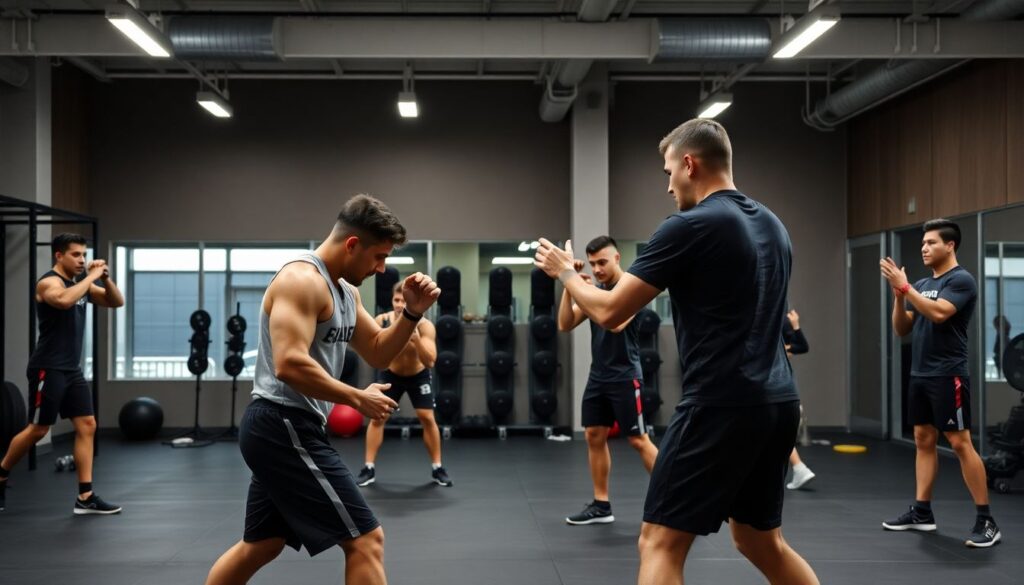
Combine technical and physical work in both sessions, with one slightly harder conditioning focus and one lighter, more tactical focus. Drop non‑essential exercises and keep total volume modest.