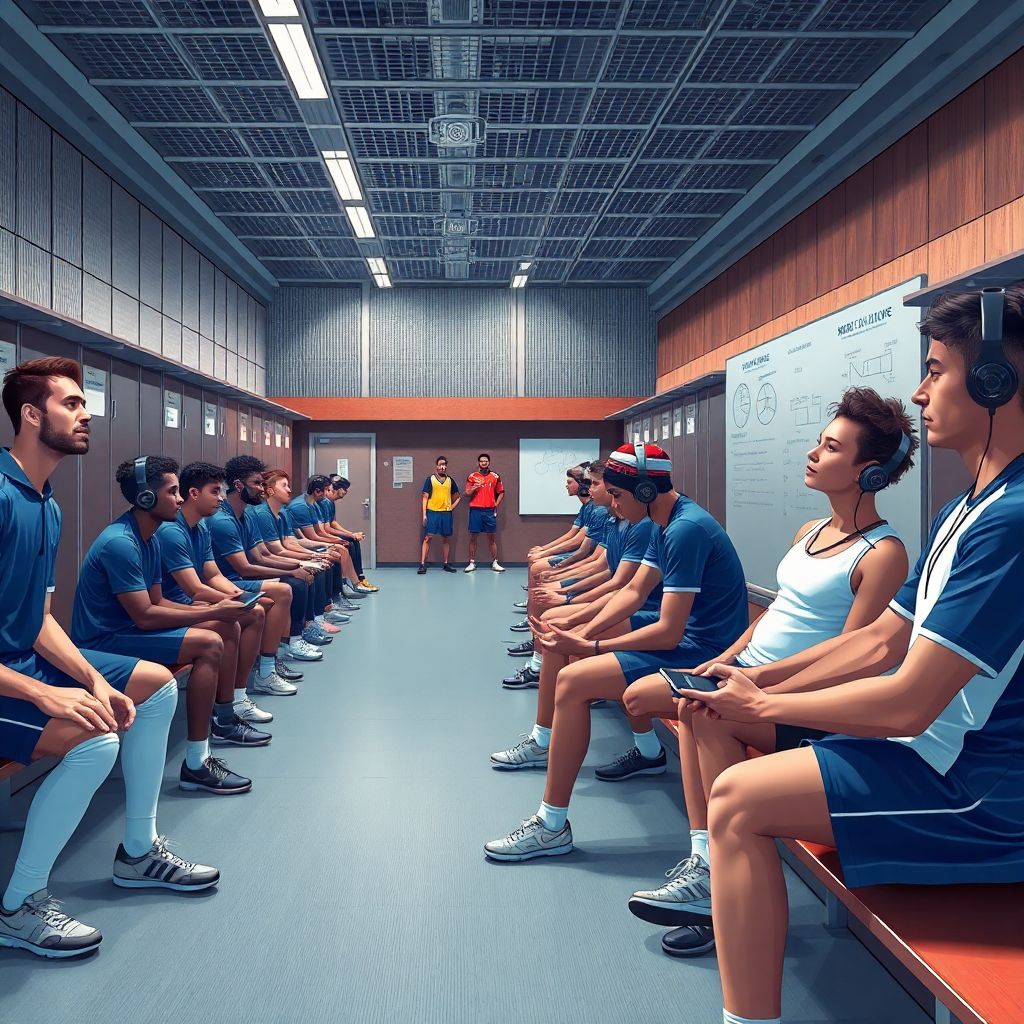
Why pre-game mental prep matters more than ever in 2026
Elite sport in 2026 is brutally simple: everyone is strong, fast and well-prepared physically.
The real difference? Who can control their mind in the 5–10 minutes when everything starts to shake: the walk from the locker room to the field, the national anthem, the first mistake, the first bad call.
That’s where preparación mental deportiva para atletas de alto rendimiento has gone from “nice extra” to “non‑negotiable”. Clubs now invest in cognitive labs, VR pressure simulators, sleep coaches and neurofeedback devices the way they used to invest only in gyms and physios.
In this article we’ll break down, in plain language:
– What top athletes actually do in the hours and minutes before competing
– How their rituals, routines and concentration techniques look *today*, not ten years ago
– What you can copy right now (even without a big-budget staff)
No magic, no mysticism. Just practical mental tools backed by current sport science.
—
The new pre-game mindset: from “motivation” to “mental systems”
From hype to calibration
Old-school approach:
“Get fired up, scream in the locker room, listen to a banger playlist, think about how much you want to win.”
Modern approach (what you see in 2026):
“Calibrate your nervous system to the right level of activation for your role and sport.”
That means:
– Some athletes need to calm down (lower heart rate, reduce anxiety)
– Others need to activate (avoid apathy, get sharp and explosive)
– Most need a structured way to get into a consistent “ready” zone on command
So “mental preparation” is less about being more emotional and more about being *more precise*.
—
Core principles of elite pre-game mental prep
1. Consistency beats superstition
Top players still have “lucky” socks or rituals… but performance staff quietly translate superstition into repeatable routines:
– Same sequence of actions at the same times
– Same type of breathing, imagery, mobility
– Same trigger phrases or gestures
Your brain loves predictability under pressure. A stable pre-game script tells your nervous system: “We’ve been here before, we know what to do.”
2. Control what’s controllable
Modern mental prep focuses on three levers you fully control:
– Attention – what you look at, listen to, and mentally rehearse
– Interpretation – what you tell yourself about nerves, noise, mistakes
– Behavior – breathing, posture, timing, and the order of your actions
Everything else (referees, weather, social media noise) is treated as “background noise, not command center.”
—
Modern pre-game rituals: what actually happens in 2026
Locker room routines 60–90 minutes before start
In top clubs and national teams, that time is no longer random. It’s segmented. A typical structure might be:
1. Arrival reset (5–10 minutes)
– Phone away or on “focus” mode
– 1–2 minutes of slow breathing or a short body scan
– Quick check-in: “How’s my energy from 1–10? What do I need: up or down?”
2. Tactical and cognitive priming (10–20 minutes)
– Short, *specific* visualization of game scenarios
– Brain warm-ups: reaction apps, light boards, or simple coordination drills
– 2–3 “if–then” scripts:
– “If we concede early, then I do X.”
– “If I miss my first shot, then I say Y to myself.”
3. Physical warm-up with mental cues (20–30 minutes)
– Every physical drill paired with a mental focus:
– Sprints + “explode on command” cue
– Passing + “scan before touch” cue
4. Pre-tunnel focus (5 minutes)
– Noise gets louder, tension rises
– Athletes shift to their personal micro-rituals: breathing, music, self-talk, or a specific gesture
Personal micro-rituals of elite athletes
Most pros have a small 1–3 minute “zone entry” they can do anywhere. Common elements:
– Put on left shoe first, then right – but with an explanation: “this marks the switch from outside life to competition.”
– Touch the locker, a line on the pitch or the goal with the same intention phrase every time.
– Short audio: a 60–90 second track with a consistent tempo to anchor state.
– 3–5 deep breaths with a specific count (e.g., in 4 seconds, out 6 seconds).
The difference in 2026 is that these aren’t random quirks. Many are created together with a coach de mentalidad deportiva para futbolistas de élite or a sport psychologist and then tested and refined.
—
High-tech trends in pre-game mental preparation (2026 edition)
Neuro and digital tools you’ll see in elite environments
Without brands, here are typical tools used in programas de entrenamiento mental para deportistas profesionales:
– HRV (heart rate variability) tracking
To see if an athlete is over-activated or flat before the game and adjust breathing or activation drills accordingly.
– Neurofeedback headbands
Short 3–5 minute sessions to practice shifting into “focused but calm” brainwave patterns.
– VR pressure reps
Virtual recreations of hostile stadiums, penalty shootouts, tie-breaks, final serves – so the nervous system stops treating them as “unknown territory.”
– Cognitive warm-up apps
Reaction time, decision-making under noise, dual-task challenges – all integrated in the last 45–60 minutes pre-game.
If you don’t have access to this tech, you can still copy the *concept*: give your brain a warm-up, not just your muscles.
—
Step-by-step: build your own pre-game mental routine
Here’s a simple 7-step framework you can adapt. This is the “DIY version” of what’s taught in a good curso online de psicología deportiva y concentración prepartido.
1. Define your ideal pre-game state
Be specific. Not “confident” or “motivated”, but something like:
– “Body: light and explosive, not heavy.”
– “Mind: sharp, not overthinking.”
– “Emotions: alert, not anxious, not sleepy.”
Write 3–5 adjectives that describe your best performances. That’s your target state.
2. Audit what you’re doing now
For the next 3 matches or competitions, note:
– What time you wake up
– What and when you eat
– Screen time before the game
– Music, conversations, social media
– What you do in the last 60 minutes
Then rate your mental state from 1–10 before each game. Patterns will jump out.
3. Create a 3-layer routine
Use this structure:
1. Macro (game day)
– Wake-up time
– Meals and hydration
– Social media limits
– Naps or rest slots
2. Meso (90–30 minutes before start)
– 5-minute reset (breathing, mobility, or both)
– 5–10 minutes of imagery
– 5 minutes of cognitive or decision drills
3. Micro (last 5 minutes)
– 3–6 deep breaths
– 1–2 key phrases
– 1 physical cue (gesture, posture, touchpoint)
4. Lock in a breathing protocol
You don’t need anything fancy. Two options:
– Down-regulation (for anxiety)
– Inhale through the nose 4 seconds
– Exhale through the mouth 6–8 seconds
– 8–12 breaths in total
– Up-regulation (for low energy)
– 2 quick nasal inhales, 1 long exhale
– 10–20 cycles
– Pair with stronger posture and brisk walking
Use the one that moves you toward your ideal state.
5. Script your self-talk
Under stress, your brain will default to whatever phrases you’ve practiced most. Choose them consciously:
– For mistakes: “Next action.” / “Reset now.”
– For fear: “I’ve handled this level before.”
– For overexcited states: “Slow brain, fast body.”
Write 3–5 short phrases and repeat them daily in training, not only on match days.
6. Visualize scenarios, not highlights
Imagery works best when it includes obstacles. Once or twice pre-game:
– Close your eyes 3–5 minutes
– See 3 types of situations:
– You execute your role perfectly
– You face a problem (mistake, goal against, pain, bad call)
– You respond well and recover quickly
Add sound, speed, and emotion. You’re not chasing perfection; you’re rehearsing resilience.
7. Test, tweak, and document
For 4–6 games:
– Use roughly the same routine
– After each game, write:
– “What helped?”
– “What felt forced or useless?”
– “What will I change next time?”
That’s the same experimental mindset used in servicios de coaching deportivo para mejorar concentración y rendimiento at high-level clubs.
—
Real-world examples of elite pre-game habits
Team sports (football, basketball, hockey)
Common patterns among top players:
– Headphones are not just for vibe
Many have 2 playlists:
– A calm one for early pre-game
– A more intense one just before warm-up
– Eye discipline
They deliberately avoid watching the crowd or media screens too much before the start, and focus on:
– Teammates
– The field
– The ball or puck
– Micro-huddles
Small 2–3 player circles to repeat 1–2 tactical cues and one emotional anchor (“we stay calm if they score first”).
Individual sports (tennis, athletics, combat)
Here ritual control is even stricter:
– Warm-up as a mental script
Exact order of drills, same timing, same internal cues. If something breaks the pattern (delays, schedule changes), they have a “short version” pre-planned so they don’t panic.
– Pre-start isolation
Head down, limited small talk, sometimes deliberate avoidance of eye contact with opponents. Not arrogance – just bandwidth protection.
– Outcome parking
5–10 minutes before the start they stop thinking about podiums, contracts or rankings and move to:
– “1–2 key process goals”
– “1–2 technical checkpoints”
—
How pros deal with 2026-specific distractions
Social media, 24/7 criticism and hype
The mental load in 2026 is heavier than ever:
– Live reactions during warm-up
– Personalized abuse or hype in DMs
– Viral clips of every mistake
Modern mental routines now include digital boundaries:
– Phones handed to staff 60–90 minutes before start
– No scrolling through comments on game day
– Pre-written responses for post-game, to avoid emotional posting
Athletes treat social media like nutrition: something that can fuel or poison performance depending on timing and dose.
Data overload
GPS, xG, heart rate, recovery scores, tactical dashboards. It’s easy to drown in numbers.
Elite mental prep now includes:
– “One metric” rule before competition:
– Each athlete focuses on 1–2 simple, controllable cues instead of 12 KPIs.
– Decoding sessions earlier in the week:
– Data is processed with staff days before, so game day is just execution.
—
Short checklist: is your pre-game mental prep elite-level?
Ask yourself these 10 questions
1. Do I have a *written* game-day routine, or do I improvise every time?
2. Can I describe my ideal pre-game state in detail?
3. Do I know 1 breathing pattern that reliably calms me down?
4. Do I know 1 technique that reliably activates me when I’m flat?
5. Have I scripted what I’ll say to myself after a big mistake?
6. Do I rehearse tough scenarios, not just highlight plays, in imagery?
7. Is my warm-up always paired with clear mental cues?
8. Do I protect myself from social media noise before competing?
9. Do I reduce complex stats to 1–2 simple performance focuses on game day?
10. After games, do I review my mental routine or only my physical and tactical performance?
If you can answer “yes” to at least 7 of these, your mental preparation is already above average. If not, you have clear starting points.
—
Putting it all together
The simple formula behind elite concentration
When you strip away the tech, the science and the buzzwords, top-level pre-game mental prep in 2026 rests on three pillars:
– Stable routines – so your nervous system feels at home in hostile environments
– Targeted tools – breathing, visualization, self-talk, and attention control matched to your needs
– Continuous tuning – treating your mind like a skill that can be trained, not a fixed personality trait
You don’t need a huge staff to start applying this. You can:
– Design a basic 60-minute pre-game script
– Add one breathing pattern
– Add one short imagery session
– Add 3–5 self-talk phrases
– Review and tweak after each competition
That’s the same logic behind what the best environments and mental coaches are doing – just scaled down to the individual level.
If you treat mental preparation with the same seriousness as your physical training, the difference won’t just show up on game day. It will change how you walk into every high-pressure moment of your career.