
Mental preparation before penalties means installing clear routines, calm breathing, focused attention and confident decision-making so your technique appears automatically under stress. Professionals build pre-kick rituals, use visualization, control arousal and simulate pressure in training so that a penalty in minute 1 feels the same as in minute 120.
Core mental anchors to set before stepping up
- Decide your target and run-up pattern in advance and repeat them consistently in training.
- Use 1-2 simple técnicas de concentración para tirar penaltis (breathing + cue word) every time.
- Separate outcome from process: focus on your steps, not on the score or consequences.
- Accept nerves as normal signals, then redirect them into strong body language.
- Rehearse penalties mentally before training and matches, not only on the pitch.
- After every penalty, review briefly what you controlled well and what to tune next time.
Pre-kick routine templates used by professional takers
Pre-kick routines reduce thinking and keep you on a safe, automatic script. They suit most outfield players, from youth to elite, especially in tournaments. Avoid building routines that are too long, superstitious or impossible to repeat in different stadiums or weather conditions.
- Fix a consistent starting point. Choose your spot on the edge of the box, place the ball the same way, and take the same number of steps back and to the side.
- Add one grounding cue. Look at the ball, then at your chosen target, repeat a short word like «through» or «corner» in your head once.
- Standardise timing. From whistle to run-up, keep a similar rhythm in training and matches so your body clock learns it.
- Lock your decision early. Decide side and height before stepping back; only change if the spot collapses or the ball moves.
- Use body language. Stand upright, relax shoulders, and keep head still to send confidence signals to yourself.
- Rehearse under light fatigue. Practice your full routine at the end of sessions, not just when you are fresh.
Pro tip: Film your routine once a week and compare it to match penalties to check consistency. Metric: aim for your pre-kick routine to stay within a one-second time window across at least 10 consecutive practice penalties.
Guided visualization steps to rehearse the perfect spot-kick
Visualization trains the brain to treat penalties as familiar, controllable actions. You need a quiet space, 3-5 minutes, and a clear script. A simple entrenamiento mental para penaltis can be done in the changing room, at home, or following a curso online de preparación mental para penaltis.
- Set the scene. Sit or lie comfortably, close your eyes and imagine a specific stadium where you often play.
- Add real details. Picture colours, sounds, smells, the grass, the ball, the goalkeeper and even the scoreboard.
- Run the full routine. In your mind, walk to the spot, place the ball, step back, breathe and run up exactly as on the pitch.
- Feel the strike. Sense the contact on your foot, the direction, the net moving and teammates celebrating.
- Include tough scenarios. Imagine missing and calmly taking the next one well so your brain learns to recover quickly.
- Repeat briefly but often. Do 2-3 mental penalties before training and matches rather than one long session a week.
Pro tip: Record an audio of your own visualization script and listen to it with headphones. Metric: target 10 flawless, fully vivid mental penalties in a row without losing focus.
Breathing patterns and arousal control for calm execution

Before learning the step-by-step pattern, prepare with this short checklist to make the exercises safe and effective.
- Practice first in a quiet space, seated or standing, away from the pitch.
- Stop if you feel dizzy or short of breath; the goal is calm, not discomfort.
- Breathe through your nose when possible and avoid holding your breath too long.
- Use a watch or metronome app to keep a steady rhythm for inhales and exhales.
- Once comfortable, transfer the pattern to walking and then to your penalty routine.
- Install a simple base rhythm (3-4 minutes daily). Inhale through the nose for 4 counts and exhale through the mouth for 6 counts, keeping shoulders relaxed. This longer exhale tells your body to downshift from «fight-or-flight» into control.
- Add a pre-kick reset breath. Just before your run-up, take one slow in-breath through the nose and a slightly longer out-breath through pursed lips, while your eyes briefly fix on the target area in the goal.
- Use a short box-breath under extreme stress. When you feel heart racing, breathe in for 4 counts, hold for 4, out for 4, hold for 4, for 2-3 cycles on your walk from midfield to the spot.
- Pair breath with a cue word. On every exhale, silently say your chosen word, such as «calm», «through» or «corner», to link breathing and focus into one action.
- Practice under movement. Walk slowly while keeping the same breathing rhythm you will use in matches, so the pattern survives light fatigue and movement.
- Review after each session. Rate your calmness and focus from 1-10 immediately after breathing practice to track progress over weeks.
Pro tip: Integrate one reset breath into every finishing drill, not only penalties, so it becomes automatic. Metric: aim to lower your self-rated tension at least two points (for example from 7/10 to 5/10) after 60-90 seconds of controlled breathing.
Commitment strategies: choosing and owning your shot
Commitment means deciding and not negotiating with yourself during the run-up. This is where psicología deportiva для lanzadores de penaltis focuses heavily, because indecision causes many safe, «easy» saves. Use this checklist to verify that you really own your choice before striking.
- You can name your target clearly (e.g., «low left, one ball from the post») before placing the ball.
- You keep the same decision from the moment you step back to the moment you plant your non-kicking foot.
- Your last look before the run-up goes to the target zone, not to the goalkeeper’s eyes.
- Your run-up speed and angle stay consistent; you do not stutter or change stride length at the last second.
- Your body language (chest, shoulders, head) matches an assertive, confident strike, not a hesitant poke.
- After the kick, you can describe exactly what went right or wrong in your decision, not just «I chose badly».
- In training, you deliberately repeat the same target 5-10 times in a row to strengthen commitment.
Pro tip: Pre-commit to a «default side» you trust most and only change based on clear information (e.g., scouting, slip). Metric: track how many practice penalties you strike without last-second changes and push that ratio above 90%.
Coping with external pressure: crowd, keeper games and noise
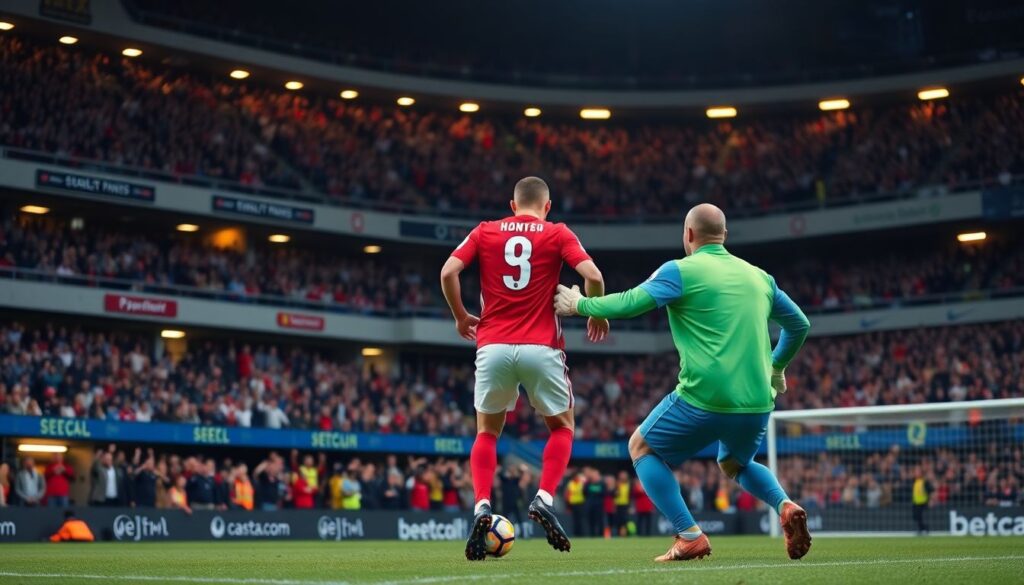
External pressure is predictable, so you can plan for it. A coach mental para futbolistas y penaltis will often teach players to treat noise and mind games as part of the script. Watch for these common mistakes and correct them in training first.
- Letting your eyes follow the goalkeeper’s movements too long during his «dance» on the line.
- Reacting emotionally to crowd noise, boos or comments instead of returning attention to ball and target.
- Changing your decision just because the keeper points to one side or talks to you.
- Speeding up your routine because you feel guilty for «taking too long» while everyone watches.
- Thinking about the importance of the moment (cup exit, derbi, contract) instead of your strike mechanics.
- Trying to ignore pressure completely instead of accepting it and using your tools (breathing, cues, routine).
- Blaming external factors after misses instead of analysing your controllable choices.
Pro tip: Ask teammates and staff to distract you intentionally in some practice penalties to inoculate against pressure. Metric: measure the difference in accuracy between quiet and noisy drills and aim to keep the drop as small as possible.
Pressure-simulation drills to transfer training to match day
To make entrenamiento mental para penaltis stick, you must rehearse it under match-like pressure. These alternative drills help different squads and levels; choose those that fit your environment, time and player personalities.
- Team consequence shootout. Divide the group in two teams, with simple, safe «consequences» (extra sprints, cleaning gear) for the losing side to raise stakes in a controlled way.
- Fatigue plus countdown penalties. After a short, intense running block, give the taker a 5-7 second countdown from whistle to shot to mimic time pressure.
- Noisy tunnel challenge. Line teammates along the run-up path to clap, shout and distract while the taker sticks to routine and target.
- Keeper psychology games. Instruct the goalkeeper to use different strategies (staying still, dancing, talking) so the taker learns to apply their tools against each style.
Pro tip: Rotate takers so many players, not just the «specialists», experience realistic pressure. Metric: record conversion rates in pressure drills and compare them with normal practice; track improvement over weeks.
Practical answers to common pre-penalty dilemmas
Should I always choose the same side for my penalties?
Use a strong preferred side that you know well, but train at least one solid alternative. In matches, keep your default unless there is clear information to change, such as scouting or pitch condition.
What if the goalkeeper moves early to my chosen side?
If you have already started your striking motion, trust your decision and focus on accuracy. If he moves clearly before your last step and you have time, you can adjust height (e.g., higher) rather than completely changing side.
How many practice penalties per week are enough?
Quality beats quantity. Integrate a small block of focused penalties with full routine 2-3 times per week, especially at the end of training when you are slightly tired, instead of long, casual sessions.
What can I do if I feel too nervous even after breathing exercises?
Shorten your tools: one reset breath plus one cue word and one clear image. If nerves remain overwhelming over time, consider working with a specialist or a structured psicología deportiva para lanzadores de penaltis programme.
Is it useful to follow a specific online course for penalties?
A well-designed curso online de preparación mental para penaltis can give you scripts, routines and feedback ideas. Make sure you actually apply each tool on the pitch and adapt it to your own style and level.
How do I recover mentally after missing an important penalty?
Allow a short emotional reaction, then review one or two technical and mental factors you can improve. Turn that review into an updated routine and start practising again within days so the miss becomes data, not trauma.
Can I combine these tools with my current technical penalty work?
Yes, and you should. Attach breathing, cues and routines to drills you already use, rather than adding separate «mental-only» blocks that feel disconnected from your football reality.