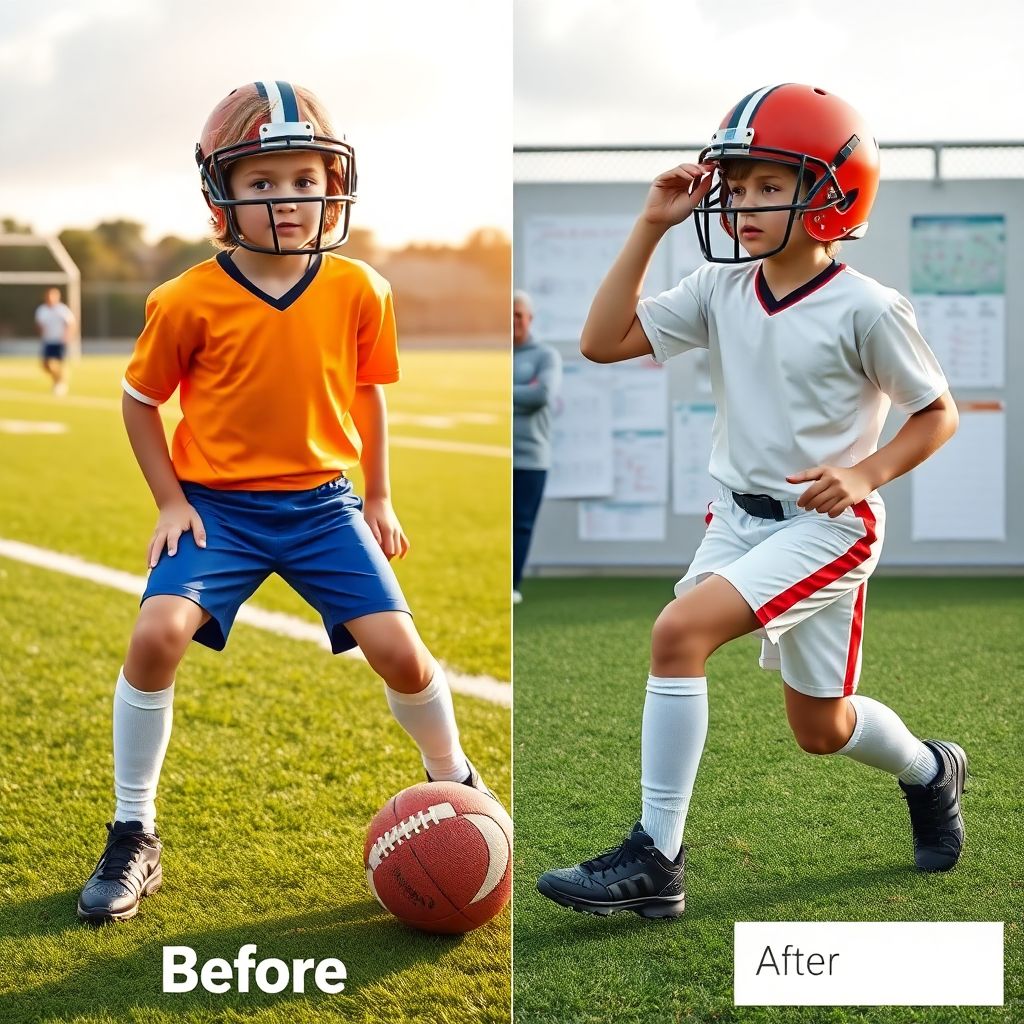
Real mentorship cases in football show a clear «before and after» when they combine tactical work, mental coaching and career planning. This guide explains how to document those changes safely: what to measure before mentorship, how to choose a mentor, what interventions to apply, and how to track long‑term impact on a player’s trajectory.
Concrete outcomes to track in mentorship case studies
- Playing context before mentorship: minutes played, role in the squad, injury history and confidence level.
- Specific goals set with the mentor: tactical, technical, mental and career objectives.
- Observable changes on the pitch: decision‑making, positioning, consistency and communication.
- Psychological evolution: resilience, focus under pressure, response to mistakes and feedback.
- Professional behaviour: nutrition, rest, punctuality, video analysis and communication with staff.
- Career moves: promotion to higher categories, contract improvements or stable role consolidation.
- Sustainability: whether improvements remain once the formal mentorship ends.
Baseline assessment: player status before mentorship
Before analysing any «before and after» case, define precisely how the player was performing and living football when mentorship started. This is true whether it is mentoría deportiva para futbolistas profesionales or for late‑academy players in Spain’s lower divisions.
A practical baseline should cover at least these areas:
- Competitive situation: division, club context, starting or substitute status, typical position and tactical role.
- Performance patterns: strengths, recurring mistakes, consistency across matches and training attitude.
- Physical and medical state: recent injuries, recovery habits, body composition (without obsessing about exact numbers) and fatigue patterns.
- Mental state: confidence, sources of pressure (family, club, social media), fear of failure or of injury.
- Professional habits: nutrition, sleep, punctuality, video analysis, relationship with staff and teammates.
Real mentorship stories are especially useful in two scenarios:
- Players stuck at the same level for several seasons, repeating the same mistakes despite working hard.
- Talented young players (for example in programas de mentoría para jóvenes deportistas) who start to lose motivation or discipline when reaching senior football.
Mentorship is usually not the best first option when:
- The player has unresolved medical issues that require specialist treatment before performance work.
- There are severe psychological symptoms (e.g. depression, eating disorders) that need clinical care instead of or before a servicio de coaching mental para deportistas de alto rendimiento.
- The club context is extremely unstable (non‑payment, constant coach changes); in that case, primary focus should be on basic security and legal advice.
- The player expects «magic solutions» without being ready to change daily habits or accept feedback.
Mentor selection and initial intervention plan
The «after» of a mentorship case depends heavily on choosing the right type of mentor and designing a realistic plan. In Spain, options range from an entrenador personal para desarrollo de carrera deportiva to a pure tactical analyst or a mental coach.
Clarify what you need before choosing:
- Main objective
- If the priority is decision‑making, game reading and positioning, a coach deportivo para mejorar rendimiento en el fútbol with tactical background is essential.
- If the priority is confidence, dealing with pressure and focus, prioritise a structured servicio de coaching mental para deportistas de alto rendimiento.
- If both areas are important, look for a professional or team that can coordinate both fields.
- Mentor profile and track record
- Experience with your age group (under‑18 vs. professional) and your position.
- Knowledge of the local ecosystem (for es_ES, understanding of Spanish competitions, promotion systems and club culture).
- References from other players, ideally including one or two «before and after» stories similar to your case.
- Tools and access required
- Access to match footage and training clips for video analysis.
- Basic monitoring of training load: wellness notes, training diary or app.
- Regular communication channel: in‑person sessions, online calls, messaging boundaries.
- Permission from the club staff when needed, especially in academies and professional structures.
- Initial plan structure
- Duration of the first cycle (for example, one half‑season, without promising guaranteed results).
- Frequency of sessions: tactical, physical and mental.
- List of indicators to track: playing time trend, anxiety before matches, quality of post‑match analysis.
- Review points: every 4-6 weeks to adjust the plan or, if needed, interrupt it safely.
Tactical and technical changes implemented
Before explaining the concrete steps, keep in mind several risks and limitations when applying mentorship to real players:
- Training changes must not contradict the club coach’s instructions; coordinate or keep adjustments subtle.
- Do not force extra workloads that exceed medical or physical recommendations, especially after injury.
- Avoid promising promotions or contracts; mentorship focuses on behaviour and performance, not guaranteed outcomes.
- Respect player privacy; when you share case studies, remove identifiable details unless you have explicit consent.
- Reassess regularly; if the player’s stress clearly increases, reduce demands and review goals.
Below is a safe, structured sequence often seen in real mentorship cases, whether in mentoría deportiva para futbolistas profesionales or ambitious semi‑professionals.
- Collect and review objective footage
Gather full matches and clips of key actions from the last weeks before mentorship.- Include both good and bad moments to avoid a biased view.
- Watch first without stopping, just to capture general feelings about role and behaviour.
- In a second viewing, stop at recurring patterns: late pressing, poor scanning, bad body shape, risky passes.
- Define one or two tactical themes
Instead of changing everything at once, choose 1-2 focus areas for the first cycle.- Examples: defensive positioning in the box for centre‑backs, receiving between lines for midfielders, timing of runs for wingers.
- Link each theme to specific game situations and to what the club coach is already asking.
- Design constrained drills aligned with those themes
Create or adapt exercises that reproduce real situations while limiting choices.- Use small‑sided games with rules that reward the desired behaviour (for example, extra points for breaking lines after scanning).
- Record short parts of these drills to compare body orientation, reaction time and communication over time.
- Integrate feedback into weekly routine
Mentorship should fit inside the existing training week without causing overload.- Schedule video or reflection sessions on lighter days (often the day after a match).
- Keep on‑field extra work short and specific, preferably warm‑up or post‑training, with clear purpose.
- Coordinate with physical staff when adding any extra running or strength work.
- Build pre‑match and post‑match micro‑routines
Translate tactical goals into simple cues.- Pre‑match: 2-3 key phrases or images («scan before receiving», «close half‑spaces», «attack back post»).
- Post‑match: quick written reflection on 3-5 actions linked to the tactical themes, not on the result alone.
- Gradually increase complexity and autonomy
As the player improves, reduce direct instructions.- Ask the player to come to sessions with self‑selected clips and questions.
- Move from very constrained games to more open tasks, checking if the new behaviours remain.
- Encourage the player to discuss insights with the club coach instead of keeping mentorship «separate».
- Document the «before and after» moments
Choose a few comparable clips from early and late in the mentorship period.- Show differences in scanning, pressing triggers, decision‑making or positioning.
- Complement video with short notes: match context, score, physical state that day.
- Use these paired examples when explaining the case to other players or staff (removing identifiers when needed).
Psychological and professional habits restructured
Changes off the pitch often explain the most durable «after» in mentorship case studies. Use this checklist to verify whether psychological and professional habits are really shifting.
- The player arrives consistently on time and prepared (hydration, equipment, mental focus) for training and matches.
- There is a simple, repeatable pre‑match routine that calms nerves instead of increasing tension.
- The player can describe mistakes after a game without excessive self‑blame or excuses.
- Sleep and recovery habits are more regular; late‑night screen time and disruptive activities are reduced.
- Nutrition choices before and after training follow an agreed plan, without extreme or risky diets.
- The player uses video or notes proactively, asking specific questions rather than passively listening.
- Conflict with coaches or teammates is handled with more constructive communication and less impulsivity.
- The player separates external pressure (family, agents, social media) from controllable daily behaviours.
- Motivation is less dependent on immediate results and more on process goals (for example, tactical tasks achieved).
- The mentor gradually becomes less central as the player makes more autonomous, thoughtful decisions.
Quantitative and qualitative milestones during mentorship
Real mentorship stories fail when progress measurement is confusing or unrealistic. These are common mistakes to avoid while tracking both numbers and narrative in a case study.
- Focusing only on minutes played without considering context (injuries in the squad, coach change, tactical system).
- Using very short periods (one or two matches) to judge whether the mentorship «works» or not.
- Ignoring qualitative signs such as better body language, calmer reactions to mistakes or improved communication.
- Comparing the player to teammates instead of to their own past baseline.
- Promising linear progress; performance usually fluctuates, especially when incorporating new behaviours.
- Collecting too many indicators (GPS data, every small stat) without a clear link to mentorship goals.
- For young players, measuring success only by selection for elite squads, instead of broader development signals.
- Not differentiating between short‑term boosts (adrenaline, novelty) and structural change in habits.
- Failing to record the player’s own perception; their sense of control and clarity is a key qualitative milestone.
- Ignoring interactions with the club staff, which can strongly influence opportunities and confidence.
Long-term trajectory: career impacts after mentorship
When the active mentorship cycle ends, the crucial question is how the player’s trajectory evolves over the next seasons. Not every situation requires ongoing one‑to‑one mentorship; there are several complementary or alternative options.
- Periodic check‑ins with the same mentor
Useful when the player has internalised most habits but wants occasional guidance.- Good fit after an intense period of mentoría deportiva para futbolistas profesionales, to avoid dependence.
- Helps adjust to new environments: promotion to a higher division, change of country or role change.
- Group programmes for young or semi‑pro players
Structured programas de mentoría para jóvenes deportistas or mixed‑age groups.- Useful when budget is limited or when players benefit from peer learning and shared experiences.
- Can focus on tactical themes, career planning or mental skills, depending on the group’s needs.
- Specialised mental coaching services
In some cases, once tactical habits are stable, the biggest lever is psychological.- A specific servicio de coaching mental para deportistas de alto rendimiento can support players facing big jumps, long injuries or leadership roles.
- Works well in combination with the club’s technical staff, who handle more of the on‑field part.
- Internal club mentoring structures
Some clubs in Spain use experienced players or staff as mentors.- Useful for integrating new signings, academy graduates or players returning from injury.
- Can complement work with an externo entrenador personal para desarrollo de carrera deportiva, as long as communication is open.
Whichever path is chosen, document long‑term impact through a mix of objective and subjective indicators: role stability, adaptation to different coaches, ability to handle setbacks and the player’s own sense of direction in their career.
Practical clarifications and common pitfalls in mentorship cases
How long should a football mentorship process last to see a clear «before and after»?
Most cases need at least one competitive phase to detect patterns and start consolidating changes. Very short processes can help with specific decisions, but structural change in habits usually appears over several months of consistent work and reflection.
Is private mentorship compatible with my club coach’s authority?
Yes, if it is handled transparently and respectfully. The mentor should support, not contradict, the club’s game model and rules. When in doubt, focus on general habits (scanning, communication, professionalism) rather than on tactical instructions that clash with the coach.
Do I need a mental coach and a tactical coach at the same time?
Not necessarily. Many mentors integrate both aspects to a functional level. If your main issues are anxiety, confidence or concentration, a specialised mental coach may be the priority; if you struggle mainly with positioning and decisions, a tactical mentor can be enough at first.
How can I measure progress without advanced statistics or GPS?
You can combine simple indicators: number of matches where you complete your tactical tasks, feedback from coaches, self‑ratings of focus, and basic notes on key actions each week. Video comparisons of similar situations before and after are especially useful and accessible.
What if mentorship increases my pressure instead of reducing it?
Then the plan must change. Share this openly with your mentor and reduce goals to a smaller, safer set of behaviours. The priority is to make you feel more in control, not more judged; sometimes this means fewer tasks and more support on coping strategies.
Are mentorship case studies useful for non‑professional or youth players?

Yes, especially when adapted to their context. Examples from similar competition levels help young or amateur players see realistic paths. The key is to avoid copying routines from elite stars blindly and instead translate principles into their own environment and schedule.
Can a mentor guarantee a contract improvement or promotion?
No. A mentor can improve your readiness, habits and visibility, but contracts and promotions depend on many external factors. Honest mentorship focuses on controllable behaviours and performance; using guarantees as a selling point is a warning sign to avoid.