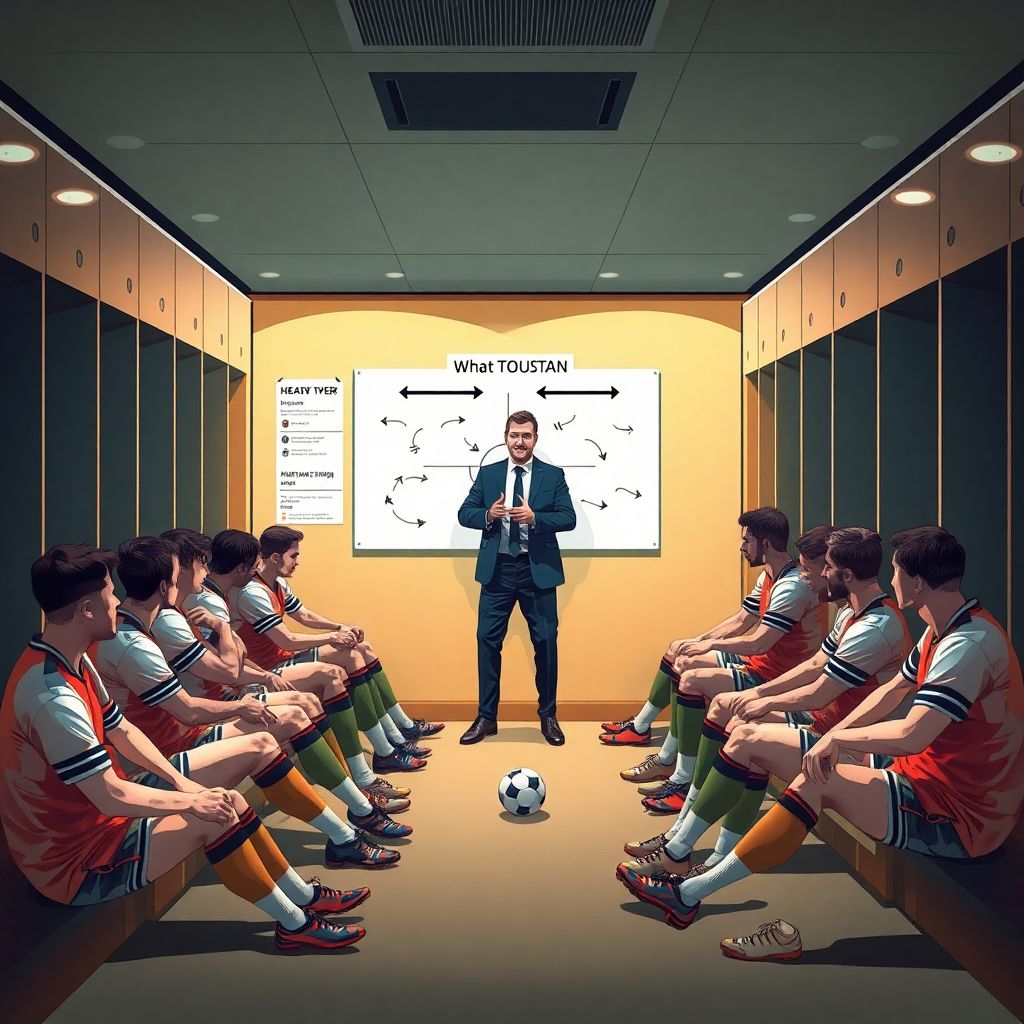
Why mental prep decides finals more than tactics
When people ask “Cómo preparar a un equipo mentalmente para una final decisiva”, they usually expect a list of motivational speeches and a couple of breathing drills. That’s exactly why so many teams collapse under pressure. The real issue is simple: under stress, players don’t suddenly become different people, they become a more extreme version of what they already are. If a team hides conflicts, overrelies on the coach’s voice, or lives off external motivation, a final will brutally expose all of that. So mental preparation is less about fireworks before the game and more about systematically reducing the number of things that can emotionally blow up on the day.
Classic rookie mistakes that sabotage a final
Mistake 1: Trying to “create” confidence 48 hours before kickoff
New coaches, and even experienced ones in their first big final, often behave like this: during the season they talk about “one game at a time”, but in the final week they suddenly change everything. Extra meetings, endless video sessions, emotional talks, slogans on the wall. They try to inject confidence instead of protecting what the group already has. The paradox is that players read this as a sign of panic: “If the coach is talking so much, maybe we’re not ready.” Confidence for a final is built months before, by aligning identity (“who we are”) and game model (“how we play”) and then simply not breaking that identity in the decisive week.
Mistake 2: Overloading the brain with tactical noise
Another rookie error: adding special schemes, new set pieces and unusual roles only for the final. Cognitively, this is lethal. Under pressure, the brain tends to simplify; it holds only what is overlearned. Every new instruction at this point competes with automatic habits and slows reactions. The result is a team that looks “nervous and slow”, while in reality it is just mentally overburdened. A sharper approach is to reduce tactical vocabulary, choose two or three key cues for each line (defense, midfield, attack) and repeat them obsessively in training and in talks.
Mistake 3: Ignoring individual emotional baselines
Beginners treat the squad as if everyone responded the same way to arousal. They use one pre‑game speech for all and expect a uniform effect. In reality, some players need activation (they perform better when they’re a bit hyped), while others need calming down, otherwise they rush decisions and commit basic errors. When a coach ignores this, the “motivational” speech often pushes the calm players into anxiety and the anxious players into panic. Without even noticing, the staff has destabilised the emotional balance they needed to protect.
Real case studies: what actually works under extreme pressure
Case 1: Turning a promotion final after a disastrous first half
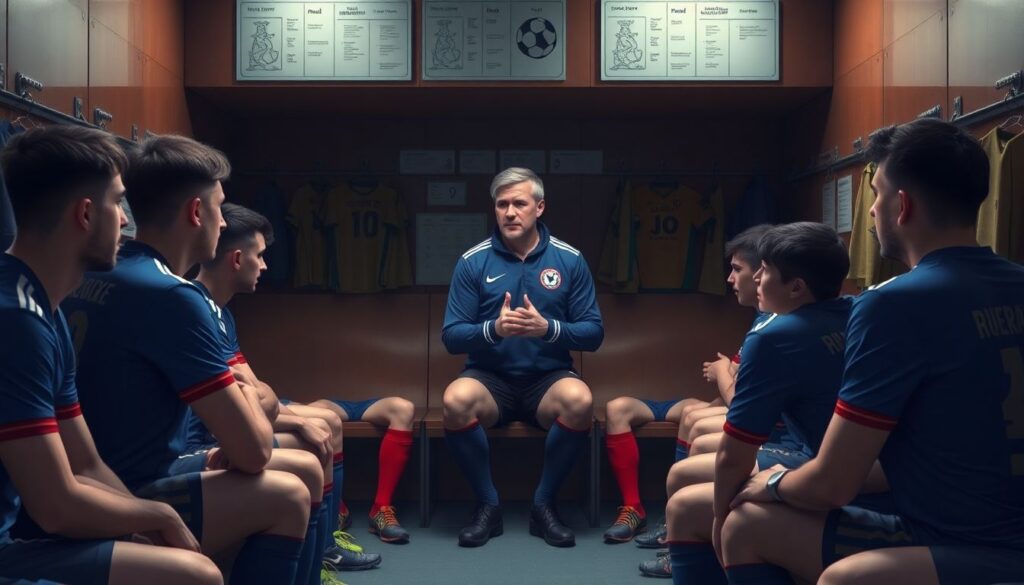
A second‑division team went into a promotion final with a solid season behind them but started the match paralysed, down 0–2 at half‑time. The coach was tempted to change formation and “shake the team”. Instead, guided by a consultant who had experience as a psicólogo deportivo para equipos de fútbol, he did almost the opposite of what instinct suggested. No tactical revolution, no shouting. They shortened the dressing‑room talk to three minutes, focused on a single, controllable target (“win the next 15 minutes”) and used a simple reset ritual: everyone rewriting on a board the three strengths that had brought them there. They came back to 2–2 and won on penalties, not because of a perfect plan, but because the staff resisted the urge to overreact.
Case 2: Handling a superstar’s anxiety in a continental final
In a continental club competition, a key striker had never played a major final. Video analysts and staff wanted him immersed in clips of the opponent’s defence. The mental‑performance coach blocked that after noticing signs of overload: poor sleep, irritability, over‑analysis of every movement in training. They agreed on an unconventional rule for the last 48 hours: zero tactical video for him, only short visualisations of his own best goals, plus one‑to‑one walks around the hotel to talk about anything but football. On match day he reported feeling “strangely calm” and scored the decisive goal. The lesson: mental preparation sometimes means removing inputs, not adding more “professional” content.
Non‑obvious solutions for a decisive‑final mindset
Designing pressure training that doesn’t feel like a show
One subtle way to build resilience is to create training scenarios where losing has real, immediate consequences inside the group, but without emotional humiliation. For example, small‑sided tournaments where the losing team has to present a short tactical analysis to the rest of the group the next day. Suddenly, every duel matters, but the “punishment” is cognitive, not punitive. This kind of design acts as entrenamiento mental para deportistas de alto rendimiento because players experience competitive stress in a controlled environment: there is status, there is evaluation, but there is also learning and humour. The key is to keep it frequent and low‑drama so that pressure stops being an exception.
Fixing attention instead of fighting “nerves”
Trying to tell players “don’t be nervous” is useless; arousal is a physiological response. A more sophisticated strategy is to work with attentional anchors. Before the final, each player identifies two reliable anchors: one external (a sound, a visual cue on the pitch) and one internal (a breathing rhythm, a keyword). The goal is not to feel calm, but to redirect attention every time the mind drifts to the result or to mistakes. Over time, these anchors become automatic: after losing the ball, the player touches a wristband, takes one slow breath and refocuses on the next action. You are not eliminating stress; you are teaching the brain where to go when stress spikes.
Alternative methods beyond the usual motivational speech
Using peer‑to‑peer leadership instead of coach‑centric control
Most teams overestimate the impact of the head coach’s speech and underestimate the informal influence network inside the squad. For a final, it’s often more efficient to work invisibly with the leaders in the dressing room two weeks before: clarify what messages they want to send, how they react to referee errors, how they support younger teammates. A short internal “leadership clinic” with senior players can achieve more than a long lecture to the whole squad. This is where coaching deportivo para preparar finales decisivas is more about orchestrating voices than owning the room. When the game turns chaotic, players will follow the emotional tone of those leaders, not the words they heard in the hotel.
Rituals designed by players, not imposed by staff
Another unconventional angle: letting the team co‑create pre‑game rituals. Many clubs impose routines—music, warm‑up order, slogans—without asking whether they resonate. A better approach is to run a short workshop a week before the final: “What helped you most before tough games this season? What can we repeat?” Out of that, the group designs a simple ritual: a circle before entering the pitch, a specific playlist, even a private phrase no one posts on social media. The psychological effect is double: players feel ownership over the moment, and the ritual acts as a bridge between past successful experiences and the present challenge.
Structuring the final week: an analytical but human plan
Day‑by‑day mental load management
Think of the final week as energy budgeting rather than pure preparation. Early in the week you can allow higher cognitive load: video, adjustments, role clarifications. As the match approaches, you must progressively lower mental noise. By the last two days, nothing new: only reinforcement of key principles, short meetings, and more time for individual routines. A good curso de preparación mental para equipos deportivos insists on this tapering model: you train full‑complexity game situations when there is enough distance from the event, and then you simplify so that players arrive mentally fresh, not “well‑informed but empty”.
Sleep, nutrition and the myth of the “special” night before
Newcomers often ruin the last night by changing everything: different bedtime, unusual pre‑game meal, long team meetings. Physiologically, the body loves predictability before stress. The goal isn’t a perfect night of sleep—most players will wake up more than usual—but the absence of extra disruptions. Encourage them to keep their normal routines as much as possible, limit blue light, and avoid late collective activities. Also, don’t turn the pre‑match meal into a ceremony; keep it similar to what worked all season. Stability of habits signals to the nervous system that, despite the context, the task is familiar.
Working with specialists without losing the locker room
How to integrate psychological support into the staff
Bringing in external help can be powerful, but only if it’s integrated. Many clubs “rent” an expert for the final and expect miracles, which players read as desperation. A better way is to involve a specialist earlier in the season, so by the time the final comes, they are part of the ecosystem. For example, the same person who informally chats with players at lunch can later run small workshops on error management or penalty routines. This creates trust and normalises mental work; it feels like part of performance, not emergency therapy.
Choosing the right modality for your context
Not every team needs a full‑time psychologist. Some benefit more from compact interventions: a few targeted sessions, or staff education. That’s where servicios de psicología deportiva para clubes y entrenadores can be especially useful: instead of focusing only on players, they strengthen the coach’s ability to read emotional states, structure training with pressure in mind, and communicate more effectively around decisive games. The common thread is continuity: tools and language introduced in October are the ones that will hold under pressure in May; anything “brand new” in final week is unlikely to stick when the heart rate hits 180.
Pro‑level lifehacks for decisive finals
“If‑then” scripts for chaos moments
One of the most effective but underused tools is implementation intentions—simple if‑then rules rehearsed in advance. For example: “If we concede a goal, then the nearest centre‑back immediately gathers the line and repeats our defensive cue.” Or: “If I miss a clear chance, then I touch my chest, exhale slowly and sprint back behind the ball.” These micro‑scripts reduce the decision‑making cost in crisis moments; the brain doesn’t have to wonder “what now?” because the response has already been chosen in a calm environment. Over time, this makes the team look “emotionally mature” when in fact it is just well‑prepped.
Building a personal “evidence file” for each player

A subtle but powerful habit for professionals is helping players assemble an “evidence file”: clips, stats and memories of situations where they performed well under pressure. Before a final, anxiety often whispers “you always fail in big games”. Having concrete counter‑examples available—short videos on a phone, or a written list—allows the brain to argue back with data, not vague optimism. Integrating this into season‑long work, for instance through a low‑key internal platform or shared folder, turns confidence from a feeling into a database the player can revisit the night before a decisive match.
Bringing it all together
Preparing a team mentally for a decisive final is less about theatrical speeches and more about system design. Avoid the rookie temptations: changing too much, overloading players, ignoring individual emotional needs. Instead, plan the final week as an energy‑management process, use realistic pressure training, and give players ownership of rituals and responses to chaos. Whether you have a full‑time specialist or just occasional support like a focused entrenamiento mental para deportistas de alto rendimiento session, the central objective is the same: when the whistle blows, players should recognise themselves and their game, not feel like actors in a script they barely rehearsed.
Комментарии