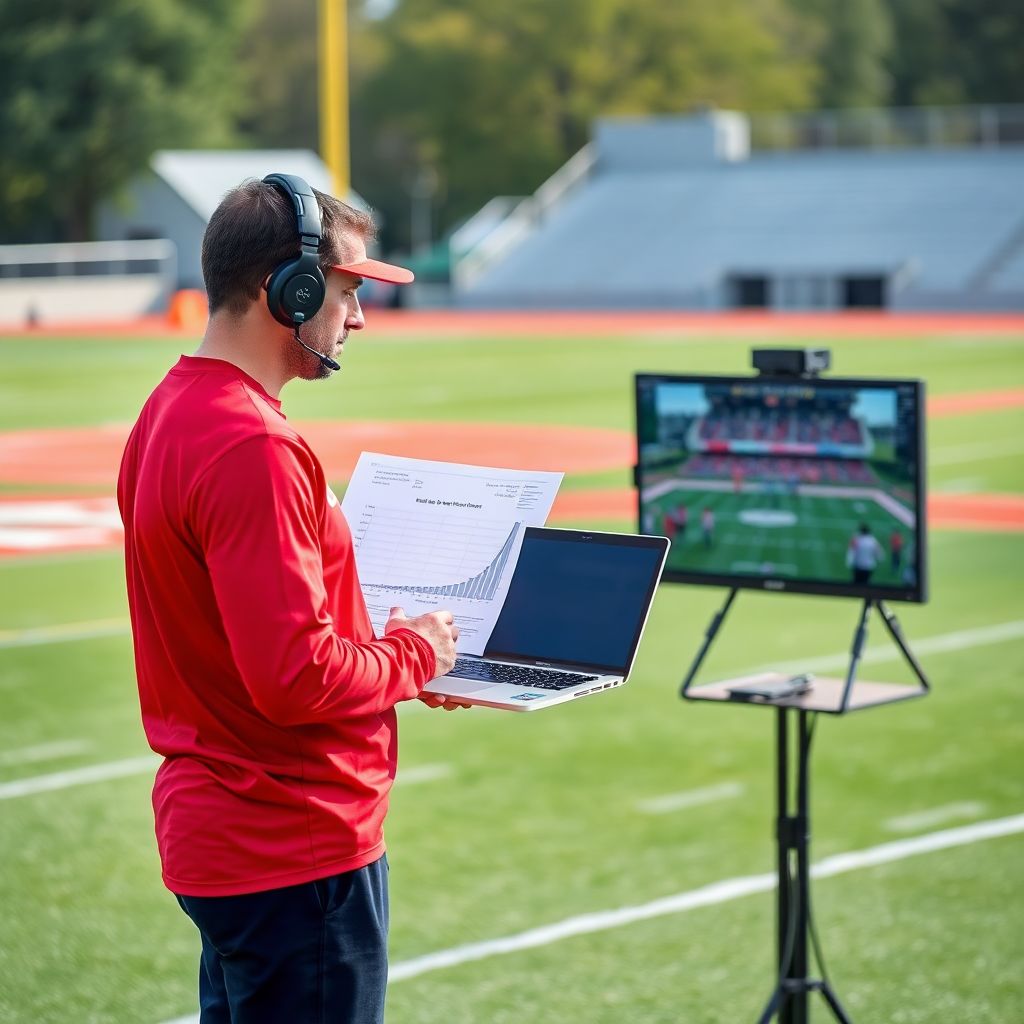
To interpret advanced match statistics safely and usefully, focus on a few key metrics (xG, xA, shot quality, field position and pressing intensity), always compare them with video, and translate patterns into one or two simple training goals per week. Avoid overreacting to a single match; look for recurring trends.
Critical Metrics Overview for Match Analysis

- Track expected goals (xG) and expected assists (xA) to understand chance quality beyond the final score.
- Use possession, field tilt and territory to see where your team actually controls the game.
- Monitor pressing actions (pressures, tackles, recoveries) to judge defensive intensity and organisation.
- Apply heatmaps and passing networks to reveal overloaded or ignored zones on the pitch.
- Compare advanced stats with video clips before changing tactics or training emphases.
- Translate numbers into 1-2 clear, realistic training priorities instead of many small adjustments.
| Metric focus | Typical pattern | Recommended coach action |
|---|---|---|
| xG for / xG against | High xG for, low goals scored | Work on finishing and decision making in the box; keep chance creation pattern. |
| Field tilt / territory | High possession in own half, low in final third | Add vertical runs and third‑man combinations to progress faster through midfield. |
| Pressures and PPDA | Very low PPDA but high xG against from long balls | Adjust pressing height or defensive line to protect space behind. |
| Pass networks | One overloaded side, isolated winger opposite | Create patterns to switch play quickly to exploit the weak side. |
| Recoveries in final third | Few recoveries near opponent box | Introduce coordinated counter‑pressing triggers after losing the ball. |
Preparing and Cleaning Match Data Before Analysis
Advanced match statistics are most useful for staff who already review video, have basic spreadsheet skills and want to go beyond simple shots and possession. They are less appropriate if you lack consistent data, rarely train during the week or prefer purely intuitive decision‑making.
Before working with any plataforma de estadísticas avanzadas para equipos de fútbol, ensure that:
- All match events (shots, passes, duels) are correctly assigned to the right players and minutes.
- Duplicate matches or friendlies you do not want to analyse are removed from your datasets.
- Scoreline, red cards and formation changes are correctly logged, as they strongly influence the numbers.
- You separate league, cup and friendly matches to avoid mixing very different competitive contexts.
If you receive data from providers or use software análisis datos fútbol para entrenadores, perform a quick sanity check each week:
- Compare total shots, goals and final score with your own match report.
- Check that substitutions and positions roughly match your tactical plan.
- Look for impossible values (negative minutes, more passes than touches, etc.).
For staff starting with estadísticas avanzadas fútbol análisis, begin with three safe data sources: your match reports, public xG data when available, and the basic dashboards of your analytics tool. Only after a few weeks of consistent use should you move to more complex custom metrics.
Possession, Transitions and Momentum: What Numbers Reveal
To analyse possession and momentum, you will need:
- Some form of event or tracking data (at least passes, shots, recoveries and losses).
- A tool to visualise timelines and zones: this can be spreadsheets, a simple plataforma de estadísticas avanzadas para equipos de fútbol, or specialised dashboards.
- Video access to check key moments where stats show big swings (e.g. after goals or cards).
Helpful herramientas de big data para rendimiento deportivo range from simple web platforms to custom Python dashboards. Choose low‑friction tools your staff will actually use weekly instead of the most complex solution.
Focus on these momentum‑related views:
- Possession share in 5-10 minute windows to see when you lost control.
- Progressive passes and carries to understand how fast you advance through thirds.
- Turnovers leading to shots within a few seconds, to capture dangerous transitions.
Combine those with qualitative questions:
- Did long possession lead to entries into the box, or only harmless circulation?
- Did you lose the ball in central zones, creating quick counterattacks against you?
- Which substitutions clearly changed the possession trend?
Understanding Expected Goals (xG), xA and Shot Quality
This section provides a safe, step‑by‑step method to use xG and xA without over‑reacting to one single match.
-
Clarify what question you want xG and xA to answer
Decide whether you want to evaluate finishing, chance creation, or defensive solidity. Limiting your goal prevents misinterpretation and keeps your focus on the team aspect you really want to improve.
-
Gather xG and xA data for both teams
Export shot and key‑pass data from your analysis platform or provider. Ensure that each shot has the following information:
- Minute, shooter, body part and shot outcome.
- Location on the pitch and type of assist (cross, cut‑back, through ball, etc.).
- xG value for the shot and xA value for the assist when available.
-
Group shots by type and location
Separate shots into categories that are meaningful for coaching: set‑pieces, crosses, cut‑backs, central combinations and long shots. This reveals which patterns generate the best chances and which are low‑value habits.
-
Compare xG and goals to judge finishing and chance quality
Look at three comparisons rather than only the total:
- Total xG for and against versus actual goals over several matches.
- xG per shot, to see if you mostly create good or poor chances.
- Individual players with repeated over‑ or under‑performance versus xG.
-
Use xA and shot origins to understand creativity
Identify which players and zones produce high‑xA passes. Check whether your attacking plan (for example, overload on one side and switch) actually leads to high‑quality assists or only to harmless crosses.
-
Connect patterns to specific tactical behaviours
For every strong or weak pattern you detect, link it to a clear game behaviour. For example: repeated low‑xG long shots from distance may indicate impatience or poor support runs around the box.
-
Translate findings into one or two training priorities
Choose a maximum of two training focuses for the week, such as improving cut‑back situations or attacking the far post. This protects players from information overload and keeps the process safe and manageable.
Быстрый режим
- Check total xG for and against and compare with the final score.
- Identify the two shot types that gave you the highest xG.
- Spot one recurrent low‑value shot habit (for example, speculative long shots).
- Design one simple finishing drill that repeats your best pattern under pressure.
- Give the team one clear message: what to repeat more, and what to reduce.
Profiling Defensive Performance: Pressures, Tackles and Recoveries
Use this checklist to confirm that your defensive metrics genuinely reflect your game model.
- Pressures are concentrated in zones where you intend to press (e.g. wide areas, near the touchline).
- High pressure periods do not coincide with frequent clear chances conceded in behind.
- Recoveries in the middle and attacking thirds lead to quick, controlled attacks rather than immediate losses.
- Key defenders are not forced into an unsustainable number of tackles or last‑ditch interventions.
- Your PPDA or similar pressing intensity metric stays within a consistent range over several matches.
- Wide players contribute to pressure and recoveries, not only central midfielders.
- After losing the ball, there is a recognisable pattern of counter‑press or retreat, not random chases.
- Set‑piece defending metrics (duels won, second balls recovered) are stable and not heavily dependent on one player.
- Defensive actions align with your physical capacity; players do not show clear fatigue or increased late mistakes.
- Video review confirms that defensive organisation, not just individual effort, underpins good metrics.
Spatial Insights: Heatmaps, Passing Networks and Zone Control

Common mistakes when interpreting spatial data can quickly lead to confusing or unsafe decisions.
- Assuming that more touches in a zone are always positive, without checking whether they create threat.
- Ignoring opponent behaviour; your heatmap may reflect their plan as much as your own.
- Judging a player solely by heatmaps, forgetting his tactical role and instructions for that match.
- Over‑valuing complex passing networks and under‑valuing simple, direct combinations that break lines.
- Comparing heatmaps from different formations or opponent styles as if they were identical contexts.
- Interpreting one match in isolation instead of building a three‑ to five‑match baseline.
- Forcing players to change their natural zones too quickly, which can hurt confidence and understanding.
- Drawing positional conclusions from very small sample sizes, such as one half after a red card.
- Using colourful graphics from herramientas de big data para rendimiento deportivo as persuasive visuals without validating them against video.
- Redesigning your structure based on a single extreme passing network that came from chasing a game.
From Numbers to Practice: Designing Drills and Tactical Adjustments
Several safe alternatives exist for turning stats into action, depending on your time, tools and experience.
- Minimalist video‑first approach: Use stats only to choose 4-6 key clips per match, then discuss them with players. This suits staff who prefer qualitative work but still want objective guidance.
- Template‑based training design: Build a small library of standard drills (finishing from cut‑backs, pressing traps, overloads) and link each to specific statistical triggers such as low xG from central zones.
- Data‑supported tactical tweaks: Once a month, review trends with your analysts and adjust one structural element (line height, pressing triggers, build‑up routes) instead of weekly tactical overhauls.
- Education‑centred pathway: Combine regular practice with a curso análisis estadístico de rendimiento en fútbol for you or your staff, so that over time you can deepen your use of estadisticas avanzadas fútbol análisis without relying entirely on external providers.
Typical Interpretation Pitfalls and Practical Remedies
Is a higher xG than the opponent proof that we played better?
No. A higher xG suggests better chance quality but ignores game context, defensive stability and match plan. Always pair xG with video and other metrics such as field tilt and transitions before judging overall performance.
How many matches do I need before trusting advanced metrics?
Use single‑match data for questions about that specific game, but wait for several matches before making big tactical decisions. Trends across multiple games are much more reliable and reduce the risk of reacting to randomness.
Should I change my striker if he underperforms his xG for a few matches?

Not immediately. Check shot types, body posture, pressure and confidence on video. If underperformance lasts for a long sequence of games and across different situations, then you can consider technical, mental or selection changes.
What if my staff find the tools too complex to use every week?
Simplify your workflow. Start with one platform of estadísticas avanzadas fútbol análisis that gives you xG, shot maps and basic passing data, and focus on one or two routine reports. Practise until this becomes automatic before adding more complexity.
How can I avoid confusing players with too many numbers?
Translate stats into simple football language and specific behaviours. In meetings, share at most one or two key figures and support them with clear video clips. The goal is clarity, not to teach players the full analytics process.
Do I really need paid tools, or can I work only with spreadsheets?
You can do meaningful work with spreadsheets, especially if you have time and basic skills. Paid software análisis datos fútbol para entrenadores mainly saves time and offers ready‑made visualisations, which can be valuable in tight weekly schedules.
How do I know if a course in football analytics is worth it?
Check whether the curso análisis estadístico de rendimiento en fútbol covers practical case studies, simple workflows and your competition level. Courses that focus only on complex models without pitch‑level applications are less helpful for everyday coaching.
Комментарии