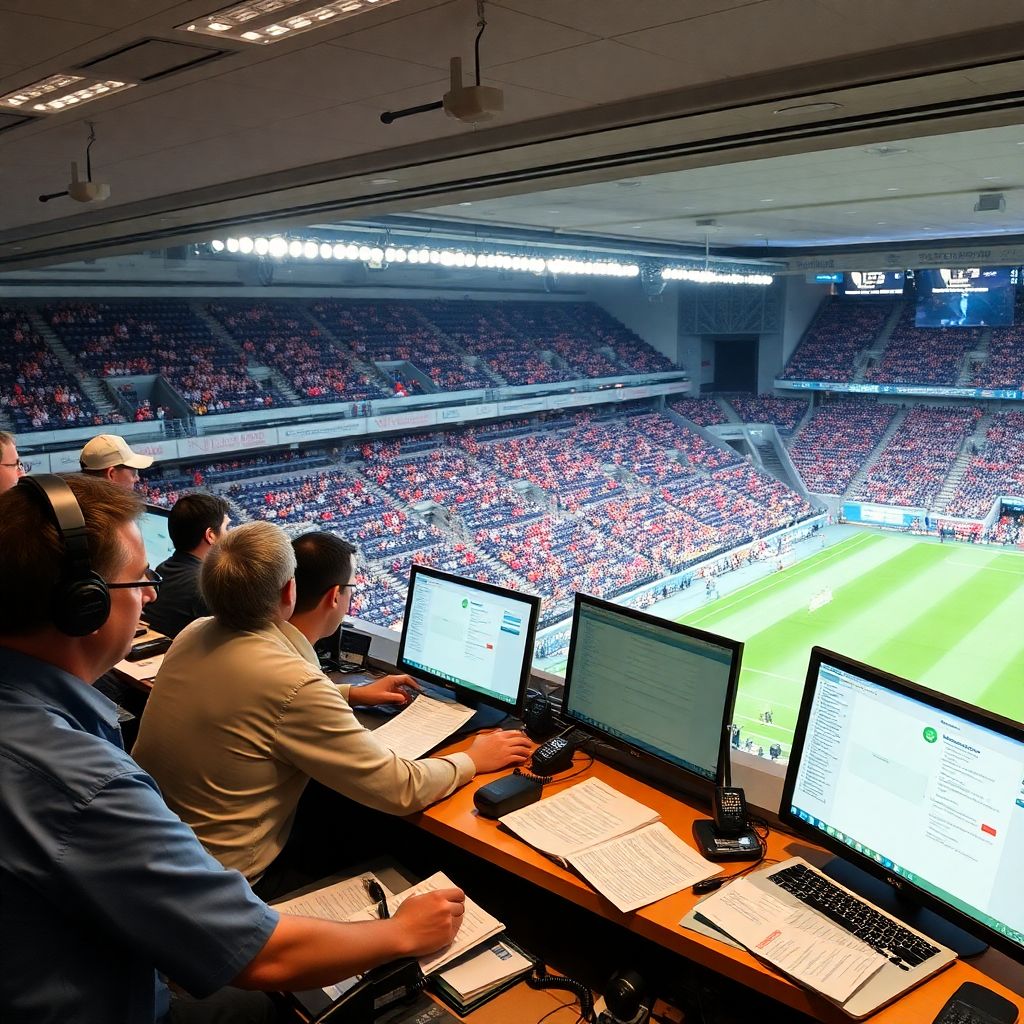
Running large live sports events safely under pressure depends on a clear pre-event blueprint, robust logistics, disciplined staffing, and a simple, rehearsed decision chain. Treat the venue as a system: map flows, define roles, set escalation rules, and support people with checklists, radios, and reliable software rather than last‑minute improvisation.
Core operational takeaways for large sports events
- Lock a single operational plan and version control it at least T‑7 days; stop uncontrolled last‑minute scope changes.
- Design people, vehicle and information flows so they never cross in unsafe ways, especially at choke points.
- Use simple, visual checklists and colour codes for roles, zones and incident levels; avoid overcomplicated tools.
- Simulate at least three critical scenarios: evacuation, medical emergency and technology failure.
- Protect decision-makers with clear authority limits, backup deputies and structured briefings every 60-90 minutes.
- Capture incidents, near miss events and timings in writing; review them within 72 hours and update playbooks.
Pre-event blueprint: site surveys, zoning and stakeholder mapping
This phase is essential for any organización de grandes eventos deportivos with significant crowd movement, media presence or complex transport. It is less relevant only for very small, local competitions with limited spectators and simple access, where a full multi-agency command structure would add bureaucracy without extra safety.
Prepare (T‑60 to T‑21 days)
- Schedule at least one joint site survey with venue, security, medical, production and your empresa de logística para eventos deportivos internacionales (if applicable).
- Collect venue drawings, capacity data, emergency exits, power maps, IT backbone and local regulations (noise, curfew, police requirements).
- Identify fixed risks: narrow gates, stairs, low ceilings, shared access with the general public, nearby roads or train lines.
Verify (T‑21 to T‑10 days)
- Define the main zones (field of play, teams, officials, broadcast compound, hospitality, fan zones, logistics, media, accreditation, medical) with clear boundaries.
- Assign each zone a single operational owner and backup, plus controlled access rules (who can enter, when and how).
- Check that crowd flows (ingress, egress, circulation, emergency evacuation) are mapped separately from vehicle and service flows.
Execute (T‑10 to T‑1 day)
- Produce a concise operations map (A3 format) combining zones, access routes, muster points and emergency exits, readable at arm’s length.
- Share tailored versions of the map with teams: security, volunteers, servicios de producción para eventos deportivos en vivo, medical, transport, media and hospitality.
- Run a table-top exercise with key stakeholders: walk through a normal match day, then an evacuation and a medical incident.
Review (T‑1 day)
- Freeze the zoning plan; document any late changes with version number, time and approval.
- Confirm that all stakeholders (including external suppliers and consultoría profesional en organización de eventos deportivos) have the latest version.
- Check signage, barriers and lighting physically match the plan; correct mismatches immediately.
Logistics and resource sequencing: equipment, transport and backup plans
Behind every smooth match there is a precise sequence for people, materials and information. This is where coordination between your operations team, venue management, broadcast partners and any empresa de logística para eventos deportivos internacionales becomes critical.
Prepare (T‑30 to T‑14 days)
- List all critical resources: structures, audio, lighting, LED, cameras, generators, cabling, barriers, medical equipment, catering, signage, ticketing and accreditation hardware.
- Identify single points of failure (for example one crane, one generator or one fiber path) and define realistic backups.
- Choose and configure software de gestión y control para eventos deportivos to track deliveries, asset locations and incident logs.
Verify (T‑14 to T‑3 days)
- Confirm time windows for load-in and load-out with venue and city authorities; book police escorts if needed.
- Lock truck schedules: arrival order, unloading bay, required staff, estimated durations and dependencies.
- Double-check import, customs and carnet procedures for international equipment; assign a single logistics contact.
Execute (T‑3 to T‑0 days)
- Use a central log (whiteboard plus digital tool) to mark arrivals, completed tasks, delays and new risks in real time.
- Physically verify that emergency routes remain unobstructed after each major installation milestone.
- Ensure servicios de producción para eventos deportivos en vivo coordinate with power and IT teams before switching on heavy loads.
Review (T‑0 to +24 hours)
- After doors open, quickly check that no temporary storage or last‑minute setups block exits, views or CCTV lines.
- Post-event, audit that all rental and hired equipment is accounted for and safely removed.
- Summarize logistic issues (late trucks, missing permits, broken gear) for the debrief.
Human factors: staffing models, shift design and stress mitigation
Even the best plan fails without rested, briefed and supported people. This section turns backstage pressure into manageable routines through clear structures and safe, practical steps.
Pre-instruction mini-checklist
- Define maximum shift lengths and mandatory breaks for all roles before recruitment starts.
- Appoint at least one welfare lead responsible for fatigue, hydration and mental load monitoring.
- Prepare simple briefing cards (who I report to, what I do, what I never do, who I call in doubt).
- Ensure all radios and headsets are numbered and traceable to specific people and roles.
- Design a lean org chart (T‑30 to T‑20 days)
Create a tournament operations chart with no more than three reporting layers from field staff to event director.
- Define functional cells: security, stewarding, transport, ticketing, broadcast, competition, protocol, medical, volunteer management.
- Assign 24/7 contact details and deputies for each cell to avoid single-person bottlenecks.
- Set safe shift patterns (T‑20 to T‑10 days)
Establish standard shifts per role, respecting legal limits and recovery time, especially for driving, security and decision roles.
- Aim to separate night setup teams from match-day command teams whenever possible.
- Schedule overlap time between shifts for proper handover (10-20 minutes).
- Recruit and allocate staff by criticality (T‑20 to T‑7 days)
Prioritize experienced hires for safety-critical, cash-handling and frontline communication roles.
- Use consultoría profesional en organización de eventos deportivos if internal experience is limited.
- Allocate language skills strategically (entrances, information points, media, VIP).
- Standardize briefings and role cards (T‑7 to T‑1 day)
Prepare short, repeatable briefings with three parts: what success looks like, three key risks, escalation rules.
- Issue printed or digital role cards with zone, tasks, radio channel and immediate supervisor.
- Practice one short radio drill per team, including clear phrases for escalation.
- Protect decision-makers from overload (event day)
Physically separate the command team from noisy or crowded environments to preserve focus.
- Limit access to the control room; appoint a gatekeeper who filters non-urgent requests.
- Rotate one senior decision-maker out of the room every 2-3 hours for rest and perspective.
- Monitor fatigue and morale in real time (event day)
Use supervisors and welfare leads to actively check hydration, breaks and stress signs.
- Empower staff to call for backup or pause tasks if they feel unsafe or unfit.
- Log any incident linked to fatigue to adjust future staffing models.
- Close the loop with debriefs (T+24 to T+72 hours)
Run short, focused debriefs by function, asking what to keep, fix and stop.
- Encourage anonymous feedback, especially from volunteers and junior staff.
- Translate feedback into 3-5 concrete changes for the next event.
Real-time command: incident escalation, communication protocols and decision gates
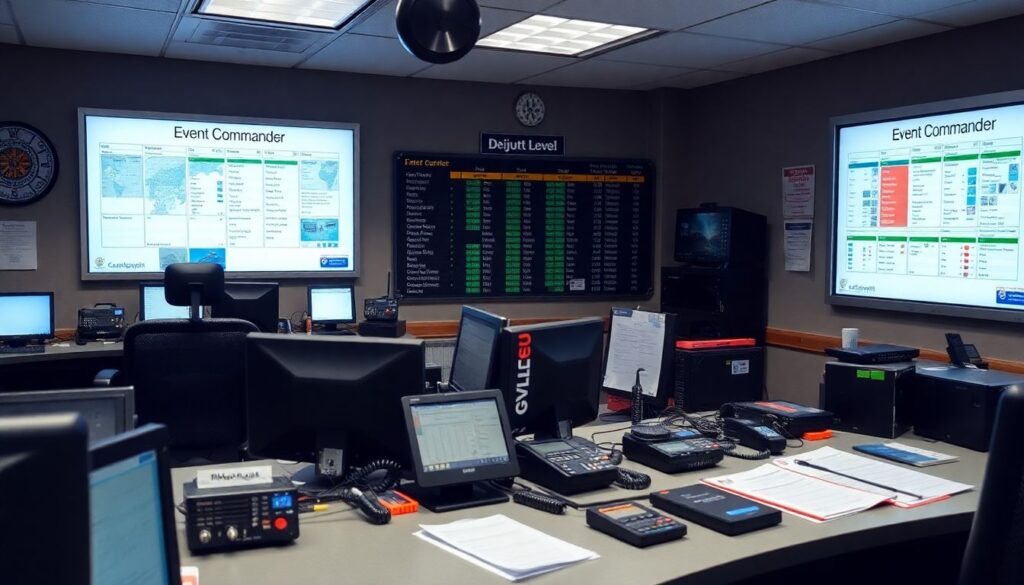
- One person is clearly identified as Event Commander, with a named deputy, and everyone knows who they are.
- There is a single, documented incident classification (for example Levels 1-3) visible in the control room and briefing packs.
- All radios have assigned channels by function, plus a reserved emergency channel tested pre-event.
- Escalation rules are explicit: when a supervisor must inform the control room, when they may act alone, and when external services are called.
- Every critical decision (stopping play, delaying gates, starting evacuation messages) has predefined decision-makers and minimum information required.
- Incident logs are updated in real time with time, location, people involved, actions taken and status.
- Cross-checks between security, medical and operations occur at fixed intervals (for example every 30-60 minutes) during peak periods.
- Public address and big screen messages have pre-approved templates for evacuation, lost children and severe weather.
- A clear cut-off time for starting the event (for example latest safe kick-off) is agreed with competition and broadcast in advance.
Risk scenarios and contingency playbooks: crowd surges, weather and security breaches
- Ignoring near-miss signs such as small bottlenecks at gates or early crowd push, assuming they will not escalate.
- Relying on a single evacuation plan without variations for blocked exits, disabled spectators or external threats.
- Underestimating weather, especially wind on temporary structures, extreme heat for spectators and players, or lightning protocols.
- Leaving cyber and IT risks to vendors only, without local backups for access control, ticket scanning and timing systems.
- Failing to coordinate with city services (police, fire, ambulance, transport) on shared incidents crossing stadium boundaries.
- Overcomplicating playbooks with long text documents nobody can use quickly under pressure.
- Not rehearsing communication for bad news: delays, match suspension, partial evacuation or no‑re‑entry policies.
- Ignoring reputational and social media impact in contingency planning, leaving no strategy for fast, accurate public updates.
- Assuming contracted servicios de producción para eventos deportivos en vivo will handle their own crises without affecting the wider operation.
Post-event review: data capture, debrief rituals and actionable improvements
After the final whistle, learning speed determines whether your organización de grandes eventos deportivos becomes safer and smoother, or repeats the same mistakes. Different review formats can be used depending on the scale, risk profile and frequency of your events.
- Lightweight internal review – Suitable for smaller matches with limited incidents. A short, structured meeting within 72 hours, focusing on 3-5 issues per function and quick adjustments.
- Multi-agency formal debrief – Appropriate for top-tier games, international tournaments or whenever emergency services were significantly involved. Include city authorities, police, fire, ambulance, transport and key suppliers.
- Independent external assessment – Useful after major incidents, high public scrutiny or recurring problems. Use consultoría profesional en organización de eventos deportivos for objective analysis and recommendations.
- Continuous improvement cycle – Best for leagues and recurring events. Capture data in your software de gestión y control para eventos deportivos, maintain a living playbook and review metrics at regular season checkpoints.
Practical questions organizers ask under pressure
How do I decide how many staff and volunteers I really need?
Start from crowd flows and risk zones, not from a fixed ratio. Map gates, stands, concourses and external perimeters, then assign minimum safe coverage per post. Validate numbers with similar past events and, if in doubt, consult experienced safety officers.
What should I do if key equipment or a truck is late on event day?
Immediately update the central logistics log, assess impact on safety and critical paths, and escalate to the Event Commander if timelines are at risk. Activate backup suppliers or alternative setups already defined in your contingency plan, and communicate revised times to stakeholders.
When is it justified to delay gates or kick-off for safety reasons?
Define thresholds in advance, such as crowd density at approaches, scanning speed, unresolved security alerts or essential system failures. If any threshold is crossed, the Event Commander convenes a quick decision huddle with safety, police and competition representatives and documents the decision and rationale.
How can I keep control of communications when everyone wants to talk to me?
Appoint a control room gatekeeper and enforce radio discipline with clear call signs and channel use. Use short briefing cycles at set times to update stakeholders, and redirect non-critical questions through functional leads instead of handling everything personally.
What is the safest way to manage lost children or vulnerable spectators?
Have a written and trained protocol including secure safe points, identification checks, logging procedures and communication rules. Only designated staff should handle these cases, always in pairs where possible, and never move a child without logging time, place and staff involved.
How do I prepare for severe weather without scaring the audience or staff?
Agree in advance on thresholds for heat, wind and storms, and prepare calm, clear announcement templates. Brief staff that weather plans exist and will be activated if needed, and rehearse internal messages so actions are confident even if the situation escalates.
What is the minimum I should document after an event if I am short on time?
Record a timeline of key incidents, any medical or security issues, major delays, decisions made and who was involved. Add quick notes on what worked unusually well or badly, and store everything centrally so the next planning team can use it.