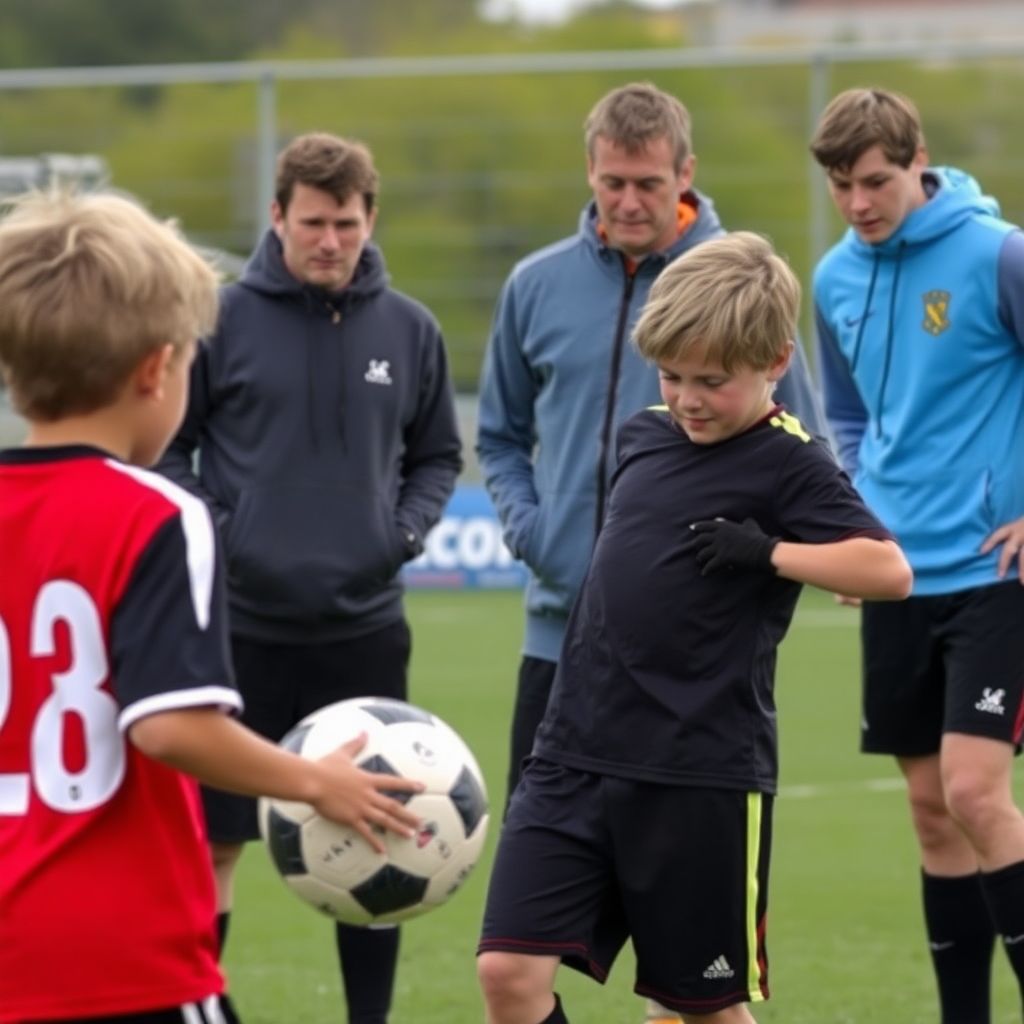
In youth matches, mentors and scouts focus on repeatable behaviours: first touch and technique under pressure, decision-making without the ball, intensity and movement, emotional control and coachability, all filtered by age and role. Understanding qué miran los ojeadores en el fútbol base helps players train and compete in a targeted way.
Core scouting priorities in youth matches
- Quality and consistency of technical actions when under real match pressure.
- Speed and logic of decisions in and out of possession.
- Physical profile: movement patterns, coordination and robustness for the role.
- Psychological traits: resilience, competitiveness, leadership and discipline.
- Alignment with coach instructions, age norms and club playing style.
- Projection: how the player might look with two to four years of training.
Technical actions under pressure
Technical actions under pressure are all ball-related skills executed when time, space or emotional state are limited by real opponents. Mentors and scouts in fútbol base rarely rate technique in isolation; they look at how stable and efficient it remains when the match becomes chaotic.
The focus is on observable details: first touch direction, body shape before receiving, quality of passes into advantage, finishing execution, and ability to repeat these actions during fatigue. These are key características que buscan los ojeadores en jugadores jóvenes because they transfer directly to higher levels of competition.
Practical observation examples:
- First touch: Does the player control the ball away from pressure? Note situations: back to goal, sideline, central areas.
- Passing: Record whether passes break lines, switch play or are only safe backwards balls.
- Dribbling: Observe 1v1 choices: when they dribble, where they dribble, and success rate against similar or stronger opponents.
- Finishing: Note calmness, shot selection and ability to hit the target rather than only power.
How to record: for each player, write 2-3 concrete examples per half, using action + context + outcome, for example: «First touch under press, right flank, controlled forward and broke line». This makes post-match comparison clearer than vague labels like «good technique».
Tactical understanding and decision flow
Tactical understanding and decision flow describe how a player reads the game, chooses options and connects one action to the next. This is central to cómo llamar la atención de los ojeadores en el fútbol juvenil because it reveals intelligence, not just isolated skills.
- Positioning without the ball: Does the player offer passing lanes, balance the team shape and respect basic distances between lines? Observe especially in transitions.
- Scanning and awareness: Count how often the player looks around before receiving. More scans usually mean faster, cleaner decisions.
- Risk management: Note whether the player forces risky actions in wrong areas or adjusts risk to the match moment and zone.
- Tempo control: Does the player know when to accelerate play with one-touch actions and when to pause with an extra touch?
- Role understanding: For each position, check if the player fulfils essential tasks: full-back supporting width, pivot offering support, striker pinning centre-backs, etc.
- Link between defence and attack: Observe if the player switches quickly from losing the ball to pressing, or from winning the ball to creating advantage.
Mini-scenarios to guide observation:
- Build-up under press: Central midfielder receives facing own goal. Do they know where the free man is before the ball arrives, and can they turn or play one-touch forward?
- Counter-attack: Winger breaks with space. Do they attack the correct corridor, attract a defender and release the pass at the right moment?
- Defensive block: Striker in a low block. Do they screen passes to the pivot or press aimlessly between centre-backs?
How to record: for each player, note 3-4 «decision moments» per match with the context (zone, score, minute) and whether the choice helped or hurt the team structure.
Physical profile and movement patterns
Physical profile and movement patterns describe how a young player moves, accelerates, decelerates, changes direction and sustains intensity. In categorías inferiores, scouts are less interested in final adult physique and more focused on coordination, elasticity and repeatable work rate within a match model.
Typical scenarios where this is evaluated:
- Repeated sprints: Wingers and full-backs making overlapping or recovery runs across both halves. Note if pace collapses or stays stable after several actions.
- Short accelerations in tight spaces: Midfielders creating separation with two or three explosive steps after a first touch.
- Duels and body contact: Centre-backs and holding midfielders in aerial and ground duels. Observe timing, balance and how they use their body to protect the ball.
- Agility and turning: Forwards receiving between lines and turning quickly under pressure without losing balance.
- Endurance: Intensity in pressing and off-ball movements from minute one to the final whistle, not just isolated bursts.
How to record: instead of measuring distance, describe patterns like «maintains sprint intensity in last 20 minutes» or «loses duels when contact increases», always tied to position demands.
Psychological traits and competitive temperament
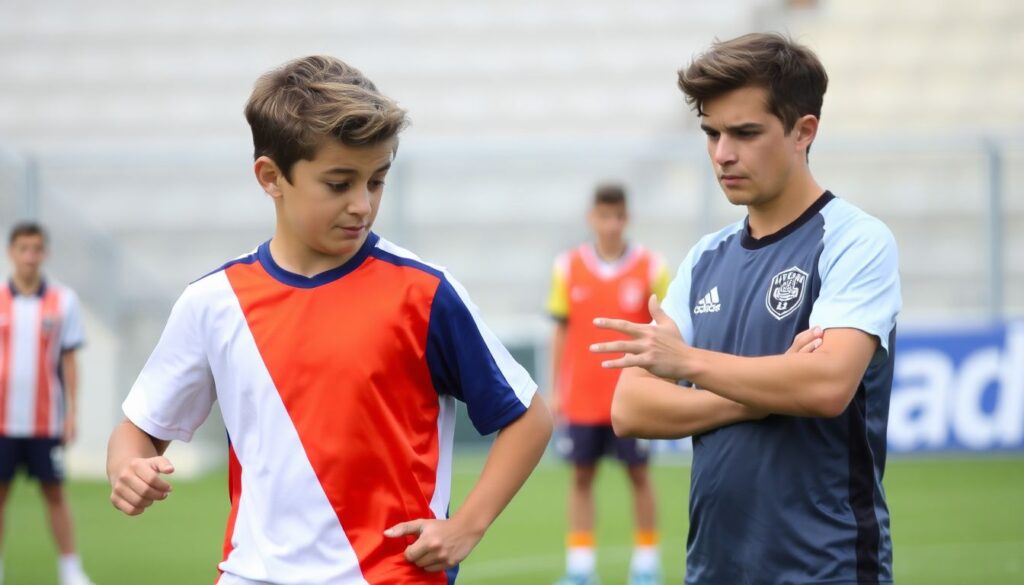
Psychological traits and competitive temperament are about how a player responds to stress, errors, referees, rivals and internal pressure. For anyone wondering cómo conseguir que un ojeador me fiche en fútbol base, this dimension is often the silent difference-maker between similar technical profiles.
Positive aspects mentors and scouts value:
- Quick emotional recovery after mistakes, with visible effort to correct the next action.
- Persistent work-rate off the ball regardless of scoreline or fatigue.
- Constructive communication: encouraging teammates, clear gestures, no blaming.
- Coachability: listens to instructions, adjusts position or behaviour after feedback.
- Healthy competitiveness: strong desire to win every duel without losing respect for opponents and referees.
Limitations or warning signs to note:
- Visible frustration leading to late tackles, arguments or disengagement from play.
- Disappearing from the match when the team is losing or under pressure.
- Ignoring tactical corrections or repeating the same error after clear feedback.
- Overconfidence: excessive risk, showboating or ignoring simple passes.
How to record: write short behaviour labels linked to moments, for example «reacts by pressing after losing ball» or «argues with referee, loses focus for two plays». Avoid psychological diagnoses; focus on what is seen.
Developmental context: coach instructions and age norms
Developmental context means interpreting what you see in relation to age, maturation, training background and coach instructions. Many consejos para destacar ante ojeadores en categorías inferiores ignore that a player might be following a role demanded by the coach rather than freely expressing all abilities.
Common mistakes and myths in match observation:
- Judging purely by size: Overvaluing early-maturing players and underestimating late developers who may catch up physically later.
- Ignoring the game plan: Criticising a full-back for not overlapping when the coach clearly asks for a conservative line.
- Confusing role with talent: Assuming a defensive midfielder has no attacking quality because their main task is to protect the back line.
- Overreacting to one match: Drawing big conclusions from a single very good or very bad performance without context.
- Misreading cultural style: In the es_ES context, short-passing styles may hide aggressive defenders who press very well between lines but rarely clear long.
How to record: before the match, if possible, ask the coach for 2-3 key tasks for each player zone. During observation, add notes like «limited by role» or «often goes beyond role» to avoid unfair conclusions.
Projection indicators for long-term potential
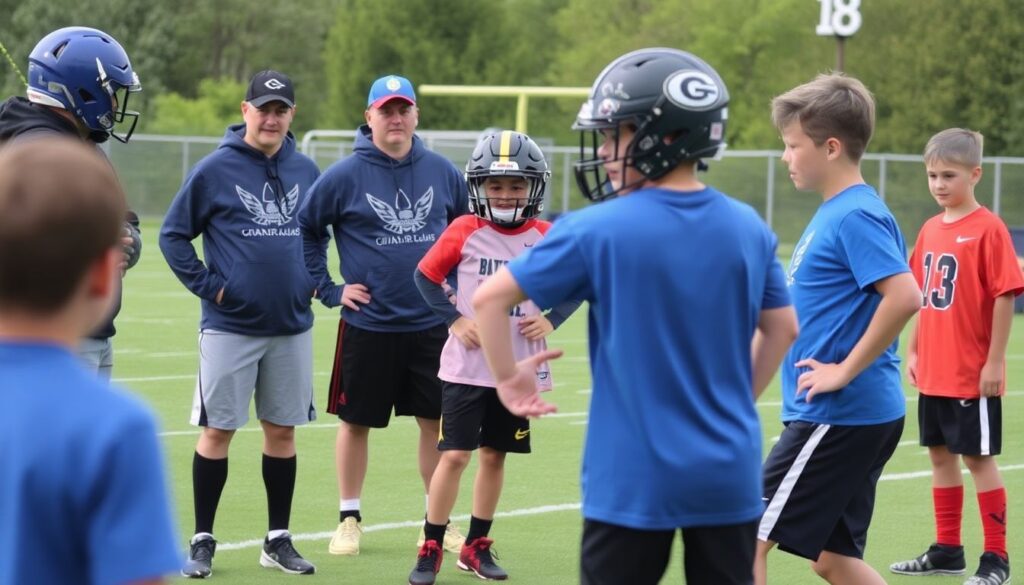
Projection indicators are signs that a young player can adapt, improve and contribute at higher levels in the future. This is where understanding deeply qué miran los ojeadores en el fútbol base becomes a tool for planning individual development, not just for selection.
Simple example of how a mentor might evaluate projection in practice:
- Check baseline quality: consistent first touch, basic passing range, acceptable intensity for age.
- Evaluate learning speed: how quickly the player applies a correction during the match or from one weekend to the next.
- Observe adaptability: performance when moved to a slightly different position or when the match plan changes.
- Estimate physical room for growth: coordination, mobility and family height pattern if known, without making rigid predictions.
- Assess training habits via coach input: attendance, punctuality, focus in sessions.
One practical mini-algorithm to review a match report and check the result of your observation:
- For each player, verify you have at least one concrete example in four areas: technique under pressure, decision-making, physical pattern, psychological behaviour.
- Re-read notes and mark with a symbol any items that appear three or more times (strengths or issues).
- Compare observed actions with player age and role; cross out any criticism that is unrealistic for the category.
- Write a three-line summary: 1) main strengths, 2) main improvements, 3) projection comment for 1-2 seasons.
- Only after this structured review decide whether and cómo conseguir que un ojeador me fiche en fútbol base is realistic now or should be a medium-term target with specific development steps.
How to record: keep a standard template per player that forces you to fill these four areas, so comparisons across matches and seasons are objective and consistent.
Practical clarifications for match observation
How many matches should a scout watch before making a decision?
Ideally, several matches across different contexts: home and away, strong and weak opponents. This reduces the risk of judging a player based on an unusually good or bad day and shows consistency of behaviours.
Is it better to focus on the ball or on one player during observation?
For detailed scouting of one player, it is more useful to follow that player, especially off the ball. For general talent detection, alternating between ball and overall team structure gives a more balanced picture.
How can a young player stand out without ignoring the team plan?
By executing the team tasks with higher intensity and concentration than others, and by making smart, simple decisions. Discipline within the game plan often impresses mentors more than isolated dribbles against instructions.
Should scouts write down statistics or only qualitative notes?
A mix is effective: simple counts of key actions, such as successful forward passes or duels won, plus short qualitative descriptions of context. This combination avoids both empty numbers and vague impressions.
Do mistakes in risky plays always count against a player?
No. In youth development, taking calculated risks in the right zones is often encouraged. What matters more is learning speed: does the player adjust decision-making after repeating a similar situation several times?
How important is the result of the match for individual evaluation?
The final score matters less than individual behaviours. A player can show excellent decision-making, effort and resilience even in a losing team, which may even highlight their competitiveness and leadership.
Can parents help by recording videos of matches for analysis?
Yes, if they do it discreetly and respect club rules. Simple wide-angle recordings can help mentors and players review positioning, movement patterns and recurring decisions after the match.