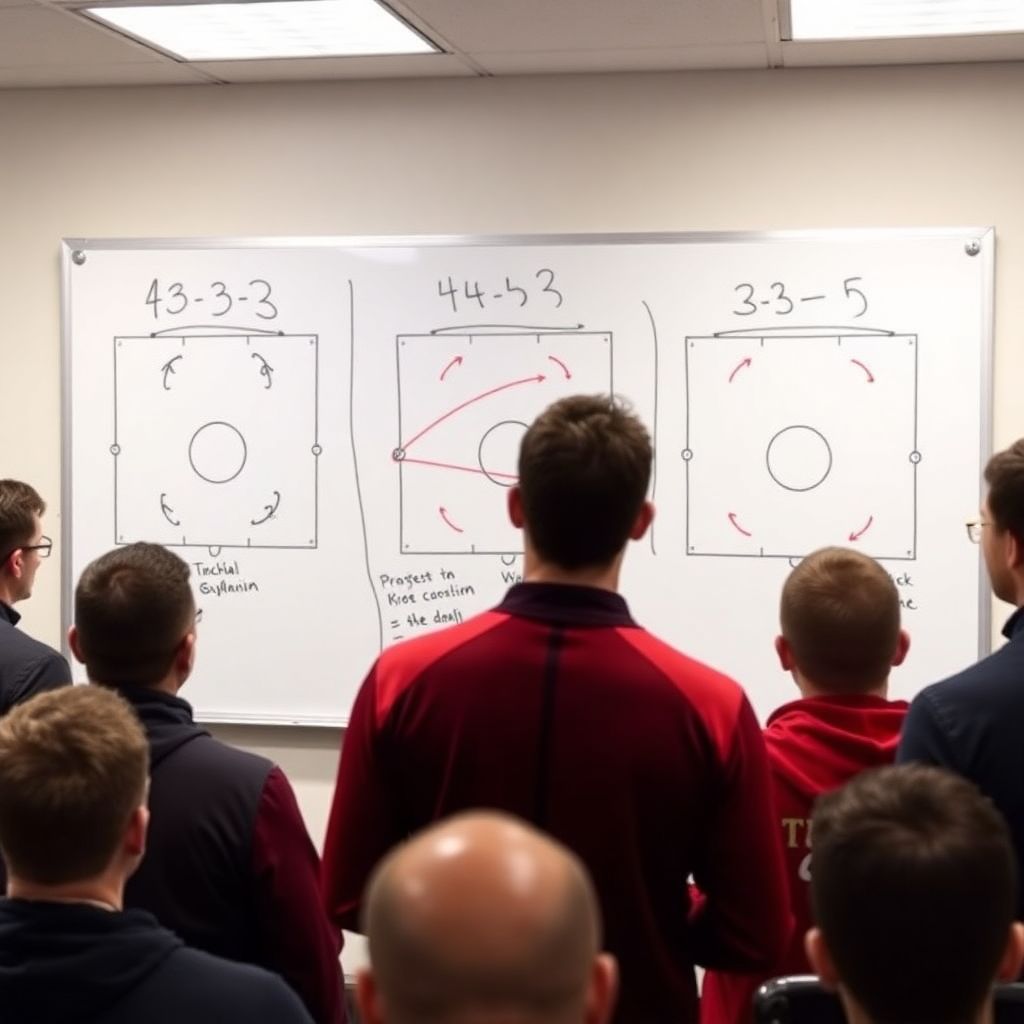
The best formation depends on your players, your pressing intensity, and how you want to attack transitions. 4-3-3 suits high pressing and wide wingers, 4-4-2 suits direct, balanced football, and 3-5-2 favours overloads in midfield and flexible pressing if your defenders are comfortable on the ball.
Concise tactical snapshot: which formation does what
- 4-3-3: maximises width and pressing, good for proactive, possession or high-energy counter-pressing teams.
- 4-4-2: most intuitive and stable, ideal when players are intermediate and you want simple roles and compactness.
- 3-5-2: strongest central presence, powerful for controlling midfield and fast vertical attacks.
- 4-3-3 favours creative wingers; 4-4-2 favours two reliable strikers; 3-5-2 favours mobile centre-backs and box-to-box midfielders.
- Low-structure teams or youth sides usually succeed faster with 4-4-2; more tactically mature squads can exploit 4-3-3 or 3-5-2.
- Switch system based on opponent: wide opponents → 4-3-3, central overload opponents → 3-5-2, physically superior opponents → compact 4-4-2.
Fundamental philosophies behind 4-3-3, 4-4-2 and 3-5-2
Before asking «qual esquema tático escolher para meu estilo de jogo», clarify the principles you want your team to live by. These formations encode different ideas about space, risk and responsibility.
- 1. Space occupation and width
4-3-3 thinks from the wings inwards: wingers pin full-backs, full-backs overlap, and interiors connect. 4-4-2 thinks in horizontal lines: banks of four slide together, wingers track back. 3-5-2 starts from the centre: wing-backs provide all width while three centre-backs and three midfielders dominate central zones. - 2. Lines of pressing
4-3-3: ideal for high pressing with three forwards locking the build-up. 4-4-2: strong in mid-blocks, guiding play outside. 3-5-2: flexible; can press with front two plus 10, or fall into a 5-3-2 low block. - 3. Central versus wide control
If your priority is central control and second balls, 3-5-2 is superior. For wide 1v1 dominance and isolating opposition full-backs, 4-3-3 is better. 4-4-2 balances both but rarely dominates either zone without specific tweaks. - 4. Complexity of roles
4-4-2 has the simplest, most symmetric roles; it works well when players have moderate tactical understanding. 4-3-3 requires more coordinated movements between full-backs, wingers and interiors. 3-5-2 is the most complex and requires clear automatisms, especially for wing-backs and side centre-backs. - 5. Risk management and rest defence
In 4-3-3 and 4-4-2 you usually defend with four at the back, which is intuitive. 3-5-2 can defend with five, increasing stability but demanding excellent communication to avoid being too passive and inviting pressure. - 6. Player pool suitability
If you naturally have three good central midfielders and two dynamic full-backs, 4-3-3 will highlight them. If you have two reliable strikers but limited wide depth, 4-4-2 or 3-5-2 will maximise their impact. If your squad includes three strong centre-backs and high-endurance wide players, 3-5-2 fits. - 7. Development versus results
For youth development, 4-3-3 teaches positional play and wing play; 4-4-2 teaches compact defending and basic combinations; 3-5-2 teaches fluidity and rotations but can overwhelm younger players if introduced too early. - 8. Cultural and league context (es_ES focus)
In Spain, players are more used to back-four structures and possession principles. 4-3-3 and 4-4-2 are easier to implement quickly, while 3-5-2 can be a useful surprise tool if opponents rarely face a back three.
Persona quick guide
- Possession coach: Usually gravitates towards 4-3-3, sometimes 3-5-2 for extra central control.
- Counterattacking coach: Often prefers 4-4-2 or 3-5-2 for verticality and clear out-balls.
- Youth developer: Starts with 4-4-2 or 4-3-3, delays 3-5-2 until tactical maturity grows.
- Results-driven senior coach: Chooses based on opponent profiling and available centre-backs.
Head-to-head comparison: situational strengths and vulnerabilities
To understand the diferença entre formações 4-3-3 4-4-2 3-5-2 futebol in practical terms, compare who they suit, their advantages, weaknesses and ideal situations.
| Variant | Best for | Advantages | Drawbacks | When to choose it |
|---|---|---|---|---|
| 4-3-3 | Teams with strong wingers, mobile full-backs, and three capable central midfielders. | Great width and pressing; clear passing lanes in build-up; flexible midfield shapes; easy to create overloads wide and half-spaces. | Can be exposed in transitions if full-backs push high; requires high work-rate from wingers; central striker can be isolated if midfield is too deep. | Use when you want proactive football, high pressing, and when you have at least one winger who can consistently beat defenders 1v1. |
| 4-4-2 | Squads with two competent strikers, disciplined wide players, and intermediate tactical level. | Very stable defensive block; simple responsibilities; good for direct play and crosses; easy to coach and adjust in-game. | Less natural central numerical superiority; wingers can tire from constant two-way running; build-up can become predictable and long-ball heavy. | Choose when facing stronger opponents, when you need compactness, or when time on the training pitch is limited. |
| 3-5-2 | Teams with three solid centre-backs and tireless wing-backs; midfielders who can cover big distances. | Central dominance; strong rest defence with three at the back; easy to create 2v1s in half-spaces; versatile pressing shapes. | Demands intelligent wing-backs; can become a passive 5-3-2; wide defending vs wingers can be problematic if wing-backs are pinned deep. | Use when opponents overload the middle or play two strikers; when you want fast vertical attacks and strong central protection. |
Comparative tactical metrics overview
| Formation | Space control focus | Pressing profile | Width management | Defensive solidity | Ideal player types |
|---|---|---|---|---|---|
| 4-3-3 | Half-spaces and wide channels | High press / counter-press | Full-backs + wingers | Medium to high (if compact) | Creative wingers, dynamic 8s, attacking full-backs |
| 4-4-2 | Horizontal compactness and central block | Mid-block, situational high press | Traditional wide midfielders | High in settled block | Disciplined wide players, two complementary strikers |
| 3-5-2 | Central corridor and half-spaces | Flexible (mid or high, depending on 10/second striker) | Wing-backs | Very high in low block, good in mid-block | Mobile centre-backs, box-to-box 8s, tireless wing-backs |
Persona callouts
- Possession coach: 4-3-3 gives most control over pressing triggers and positional play.
- Counterattacking coach: 4-4-2 or 3-5-2, depending on whether you prefer two out balls (strikers) or vertical runs from deep.
- Youth developer: Start from 4-4-2, then introduce 4-3-3 to teach half-space positioning.
Player archetypes and role adjustments per system
When deciding the melhor esquema tático 4-3-3 4-4-2 3-5-2, think in terms of profiles, not just positions. For each formation, key roles change slightly depending on whether you are a possession, counterattacking, or development-focused coach.
4-3-3 role map
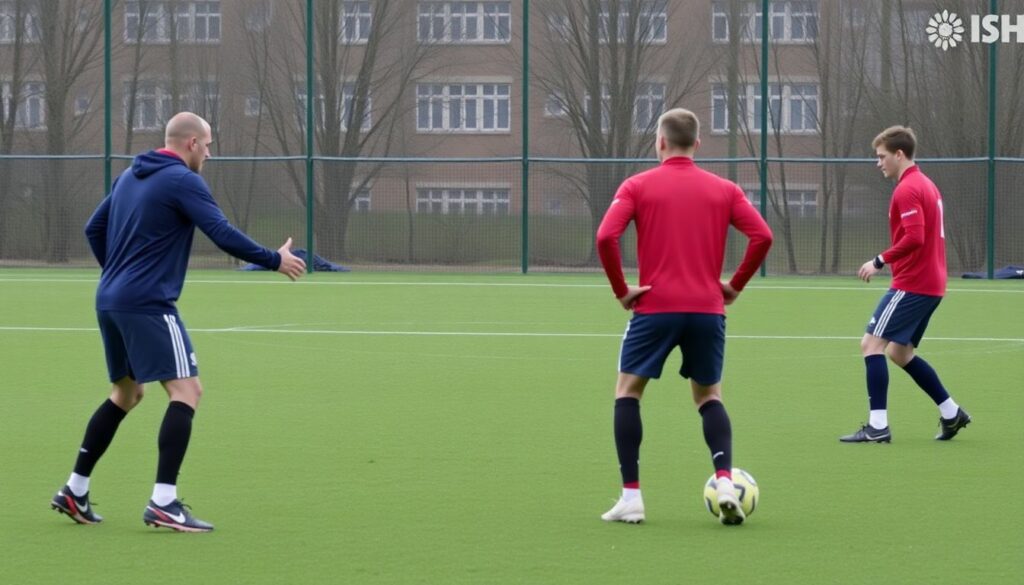
- Centre-backs: Comfortable in build-up, able to defend large spaces behind full-backs.
- Full-backs: High stamina, good crossing, aggressive in pressing wide; must recover quickly.
- Holding midfielder (6): Press-resistant, reads transitions, provides constant passing lane to centre-backs.
- Interiors (8s): Box-to-box, good at third-man runs, support wide overloads and press from inside.
- Wingers: 1v1 specialists or inverted playmakers; either stretch wide or attack inside channel.
- Striker: Can play with back to goal, attack crosses and run in behind.
If… then… scenarios for 4-3-3
- If your full-backs are weak in attack, then keep them deeper and ask a midfielder to drift wide in build-up.
- If your winger is more playmaker than dribbler, then invert him and use overlapping full-back to provide width.
- If your 6 lacks mobility, then keep one 8 deeper to protect counters.
- If your striker cannot hold the ball, then play more into channels and use wide runs from the 8s.
Persona lens: A possession coach uses the 6 as organiser; a counter coach uses wingers higher and narrower to run in behind; a youth coach simplifies by fixing clear zones for wingers and 8s.
Diagram suggestion: show 4-3-3 in a 2-3-5 attacking structure (full-backs plus 6 forming the three) with arrows from 8s into half-spaces.
4-4-2 role map
- Centre-backs: Strong in duels and aerially, ideally one with good long passing.
- Full-backs: Conservative, defend wide 1v1s; overlap selectively.
- Central midfielders: Highly disciplined; one more defensive, one more box-to-box or creative.
- Wide midfielders: Two-way runners; must track full-backs and provide width in attack.
- Strikers: Typically one target player and one runner/second striker, or two complete forwards.
If… then… scenarios for 4-4-2
- If you lack a natural 10, then use a second striker who drops between lines as a link player.
- If your wingers are weak defensively, then lower the line and keep your block compact to limit exposed 1v1s.
- If opponents overload your double pivot, then tuck one wide midfielder inside to create a temporary three.
- If your target striker is dominant, then structure set-plays and crosses around him, keeping the second striker for rebounds.
Persona lens: A counterattacking coach loves 4-4-2 for clear pressing triggers and direct runs. A youth coach uses it to teach lines and compactness with minimal confusion.
Diagram suggestion: draw 4-4-2 mid-block with arrows guiding ball outside, and counter arrows from wide midfielders and one striker running into channels.
3-5-2 role map
- Centre-backs: At least two must be comfortable stepping out with the ball; side centre-backs defend wide.
- Wing-backs: Elite endurance; must time runs to arrive in the box yet recover in defence.
- 6 and 8s: One sitter, two shuttlers or an 8 + 10 combination; key to controlling tempo and counter-press.
- Strikers: Complementary pairing: one to occupy centre-backs, one to drift and link with midfield.
If… then… scenarios for 3-5-2
- If your side centre-backs struggle wide, then keep wing-backs slightly deeper and protect half-spaces with an 8.
- If wing-backs are your best attackers, then build patterns to switch play quickly and isolate them 1v1.
- If your 10 is your main creator, then let him float behind strikers while the 8s cover transitions.
- If opponents play with three forwards, then be ready to drop one midfielder into the back line, temporarily forming a 4-4-2.
Persona lens: Possession coaches use 3-5-2 to dominate central corridors; counter coaches use it for vertical passing and deep runs; it is less common in early youth due to complexity.
Diagram suggestion: show 3-2-5 attacking structure (three centre-backs plus two midfielders) with wing-backs high and strikers staggered.
Transition patterns: build-up, counter, and defensive reset
The question «como montar time no esquema tático 4-3-3 4-4-2 3-5-2» is mainly about transitions: what happens when you win or lose the ball. Use this checklist to decide which pattern fits your players.
- Clarify your primary build-up route
Decide whether you want to progress through short central combinations (favours 4-3-3, 3-5-2) or more direct balls to strikers and wide players (favours 4-4-2). Choose the system that gives the safest repetitive patterns for your centre-backs and deepest midfielder. - Define your counterattacking identity
If you want immediate vertical balls into two strikers and wide runners, 4-4-2 or 3-5-2 align naturally. If you prefer securing the first pass and building controlled counters through midfield, 4-3-3 is more suitable. - Plan your counter-pressing or recovery
4-3-3 is ideal for counter-press because of its three central midfielders and forwards around the ball. 3-5-2 can also press well centrally but risks switches of play. 4-4-2 is better for quick retreat into a compact mid-block rather than aggressive counter-pressing. - Design rest-defence for each system
In 4-3-3, usually leave two centre-backs plus the 6 behind the ball. In 4-4-2, keep full-backs cautious and one midfielder holding. In 3-5-2, three centre-backs plus at least one midfielder secure counters, with wing-backs judging risk carefully. - Set clear pressing triggers
For 4-3-3: back-pass to centre-back, slow lateral pass to full-back. For 4-4-2: pass into opposition pivot or predictable bounce pass. For 3-5-2: pass into wide centre-back or full-back isolated vs wing-back. - Rehearse defensive reset patterns
Train how your team drops when the first press is broken. 4-3-3 typically falls into 4-1-4-1; 4-4-2 into a very compact 4-4-2 block; 3-5-2 into 5-3-2. Drill these «panic movements» so they become automatic. - Align with your persona and squad reality
Possession coaches should favour systems that allow structured rest-defence and controlled counter-press. Counterattacking coaches should prefer systems that get runners into space faster even if build-up is simpler.
Opponent profiling: how to select a formation game-by-game
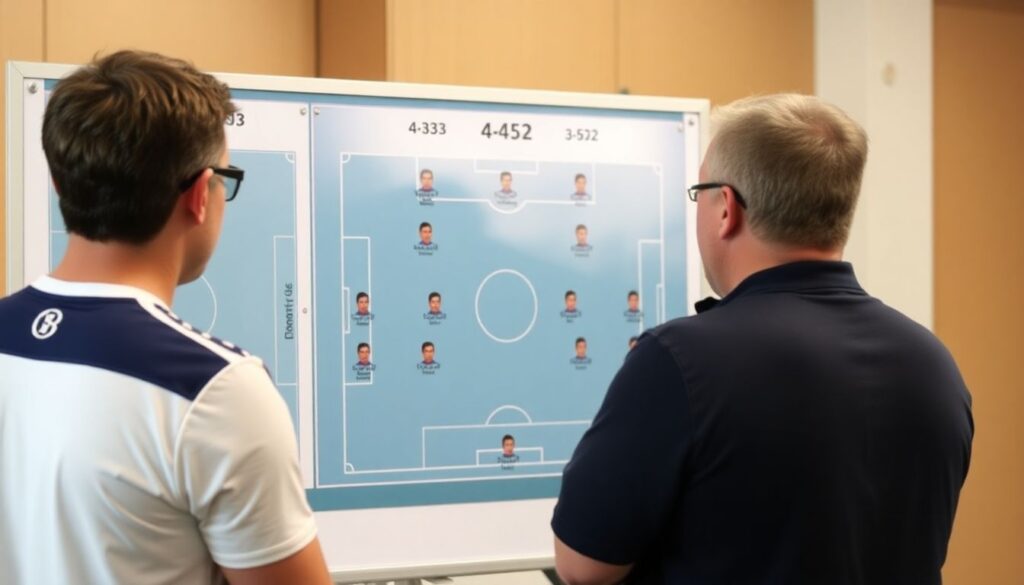
To avoid misjudging the vantagens e desvantagens dos esquemas táticos 4-3-3 4-4-2 3-5-2, analyse the opponent and avoid these frequent mistakes when adapting.
- Ignoring your own player profiles
Choosing 3-5-2 without true wing-backs or ball-playing centre-backs leads to structural problems, no matter how attractive the theory looks. - Overreacting to one previous match
Changing from 4-3-3 to 3-5-2 after one bad result can confuse players; build a clear «A plan» and adjust details instead of constantly changing systems. - Matching the opponent’s shape blindly
Mirroring a 4-4-2 or 3-5-2 can neutralise your own advantages. Sometimes keeping your strength (e.g., 4-3-3 width) against their weakness is smarter. - Underestimating wide threats
Facing strong wingers with a passive 3-5-2 can pin your wing-backs deep into a back five. In that case, a 4-4-2 with double wide protection may be safer. - Mismanaging central overloads
Going 4-4-2 against a team with three midfielders without asking a winger to tuck inside leaves you constantly outnumbered centrally. - Ignoring set-piece implications
System changes affect who marks whom on corners and free-kicks. Shifting to 3-5-2 without reassigning roles at set pieces invites chaos. - Not planning in-game adjustments
A good game-plan includes a simple switch: 4-3-3 ↔ 4-4-2 (by pushing an 8 higher), or 3-5-2 ↔ 4-4-2 (by moving a wing-back into midfield). - Personas not aligned with reality
A possession coach insisting on deep build-up in 4-3-3 with centre-backs who panic under pressure may be better off with a more pragmatic 4-4-2 for certain opponents. - Neglecting fatigue and schedule
Wing-back-heavy 3-5-2 demands huge physical output. During congested weeks, a compact 4-4-2 might help maintain intensity across matches.
Practical implementation: drills, training priorities and set-piece tweaks
For a possession-oriented persona, the «best» is usually 4-3-3, with rondos and positional games to rehearse width and half-space play. For counterattacking coaches prioritising directness, 4-4-2 or 3-5-2 suit vertical patterns. For youth developers, 4-4-2 then 4-3-3 give clear learning steps without overwhelming players.
Practical tactical clarifications and quick decisions
How do I pick quickly between 4-3-3, 4-4-2 and 3-5-2 before a match?
Check three factors: your best players’ profiles, the opponent’s main strength, and how much training time you had. If you have strong wingers and time to coach pressing, go 4-3-3; if you need simplicity and compactness, go 4-4-2; if you own three top centre-backs, consider 3-5-2.
Which system is safest for intermediate amateur or youth teams?
4-4-2 is usually safest because roles are clear, distances are short, and defensive organisation is easy to understand. Once players show good compactness and communication, you can gradually move towards 4-3-3 or 3-5-2 for more complexity and control.
Can I switch systems in-game without substitutions?
Yes, if you plan it. From 4-3-3 you can push an 8 higher to create a 4-4-2. From 3-5-2 you can drop a wing-back into the back line and push an 8 wide, forming a 4-4-2. Train these shifts so players understand cues and responsibilities.
What if I lack classic wingers but still want width?
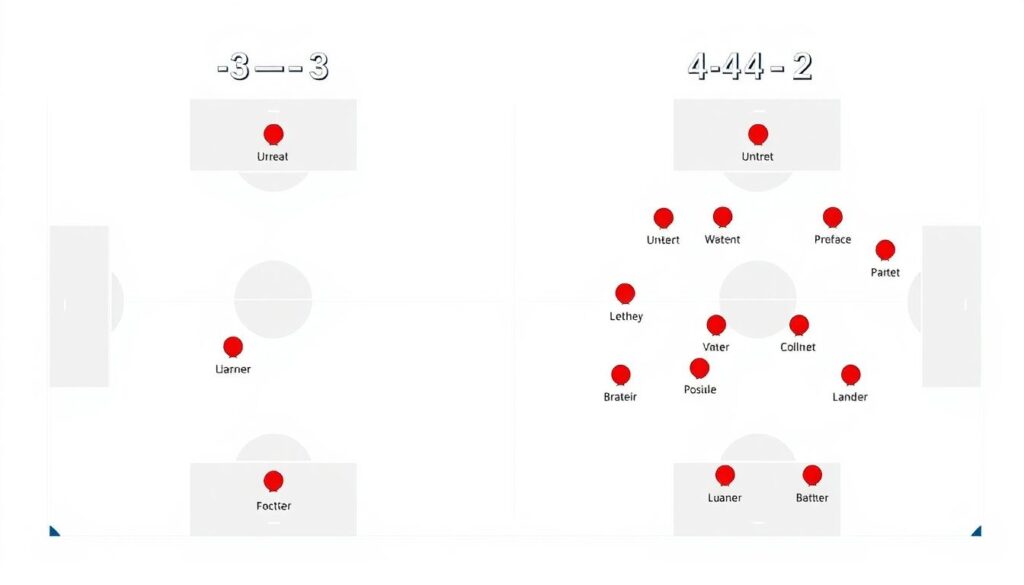
Then 3-5-2 or a narrow 4-4-2 diamond may be better, using wing-backs or full-backs to provide width. In 4-3-3 you can also use full-backs very high and tuck wide players inside as attacking midfielders, but this demands excellent rest-defence.
How do I adapt formations to a small pitch?
On small pitches, compact shapes like 4-4-2 or a conservative 3-5-2/5-3-2 are effective because they reduce space between lines. 4-3-3 can still work, but you will use more narrow wingers and short combinations rather than constant wide switches.
Which formation helps most with pressing high?
4-3-3 is generally best suited for organised high pressing due to its front three and three midfielders behind. 3-5-2 can also press high using a front three shape (two strikers plus advanced midfielder), but coordination is more complex than in 4-3-3.
How often should I change my base formation during a season?
Keep one main system as your reference and only switch when player availability or a specific opponent demands it. Constantly changing between 4-3-3, 4-4-2 and 3-5-2 without clear reasons usually confuses players more than it helps tactically.