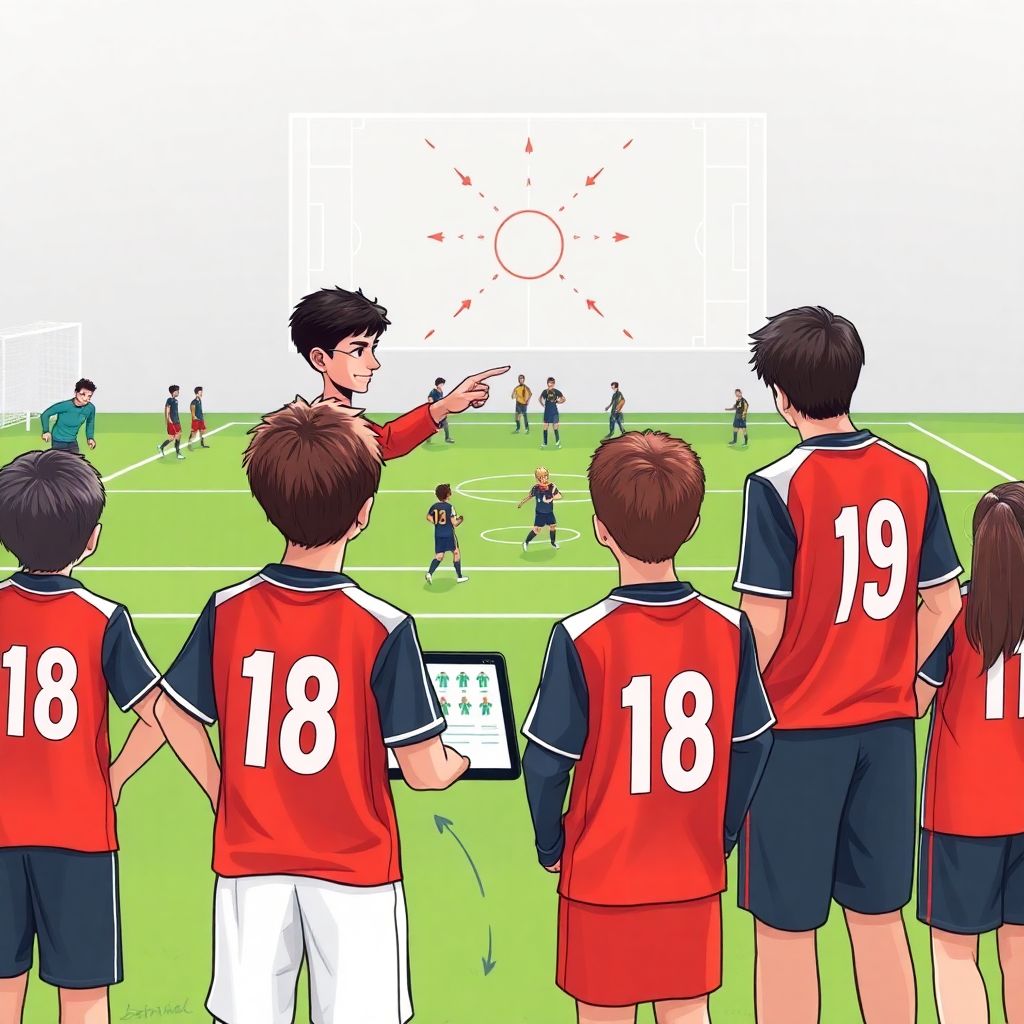
Why tactical mistakes are so common in youth football
In youth categories, most tactical mistakes don’t happen because kids “don’t understand football”, but because the environment around them is messy. Teams change systems every weekend, the coach screams conflicting instructions, parents shout different orders from the stands. The result is classic errors: defensive line too deep, no compactness between sectors, wingers not knowing when to close inside, midfielders chasing the ball instead of controlling space. If the only feedback a player gets is “run more” or “don’t lose the ball”, he never learns to read game references like opponent’s body orientation, cover shadow or pressing trigger. That’s where structured mentoring becomes a game changer: it transforms vague criticism into clear tactical cues that an 11‑, 13‑ or 15‑year‑old can actually apply in the next training session.
Young players also copy what they see on TV without understanding context, which multiplies errors when they try “pro” movements at grassroots speed and intensity. Without someone to translate those ideas to their reality, they get frustrated and think they’re “not talented enough”, when the real problem is lack of guidance, not lack of potential.
The three “invisible” mistakes almost every academy team makes
If you watch any random U13 game for ten minutes, you’ll usually spot three recurring issues: the team defends watching only the ball, attacks all at the same height, and loses shape right after transition. None of this is about “genius”; it’s about simple rules explained clearly and repeated with intention.
Reading the game instead of chasing the ball
One of the most damaging tactical patterns in youth categories is ball‑oriented chaos: five or six players collapsing on the ball carrier, leaving huge free zones behind them. Kids are naturally attracted to the ball, so if the coach doesn’t deliberately train line behavior, cover and balance, the team lives in permanent disorganization. To fix that, mentoring focuses on teaching reference hierarchies: first the ball, then the opponent, then space and finally teammates. In practice, this means explaining to a full‑back not just “don’t push too high”, but “check if your winger is inside; if yes, you stay wider and a bit lower to protect the half‑space and give the pivot a passing lane”. Youth players respond quickly when the instruction connects directly to what they see on the pitch, instead of abstract theory shouted from the touchline.
Another frequent issue is poor occupation of width and depth. You see three forwards on the same vertical line, all asking for the ball to feet, no one attacking the space behind the defense. A good mentor rewires that behaviour with small, repeated cues: one comes short, one stays between lines, one threatens depth. Once the players feel how much easier it becomes to progress, they begin self‑correcting in games.
Short, intense corrections beat long, vague speeches
Kids remember one or two clear cues per session. A mentor who picks the right cue for that week—“protect the inside”, “attack the blind side”, “close the passing lane, not the man”—will have far more impact than someone giving a 15‑minute tactical monologue nobody processes.
How mentoring closes the gap the team coach can’t cover
Even the best academy coach is limited by time and group size. He has to plan the session, manage substitutions, talk to parents, report to the club. Deep, individual tactical feedback almost always gets sacrificed. This is where mentoria futebol de base online fits perfectly: a mentor can watch the match video with the player, pause at key moments and ask, “What were your options here?” instead of just saying “wrong decision”. With screen sharing and drawing tools, it’s easy to show cover angles, defensive body shape or the optimal passing line. Because it’s one‑to‑one, the mentor adapts vocabulary and complexity to the player’s age and position, turning abstract tactics into personal solutions: “for you, as a left‑back, this is what pressing with the correct foot means in this situation”.
The same applies at team level. Clubs that don’t have a full‑time analyst can still bring in an external mentor to review games monthly with the staff. Short, focused online sessions looking at compactness, rest‑defence or build‑up patterns give the head coach a tactical mirror without attacking his authority. Players feel everyone is rowing in the same direction when the staff speaks the same “game language”.
Mentor as translator between the playbook and the player
Many youth coaches have good ideas but struggle to explain them in simple, game‑related images. The mentor often acts like a translator, taking the coach’s complex model and turning it into two or three practical rules each player can execute under pressure.
Inspiring cases: when targeted mentoring changes careers
Let’s take a real‑world‑style example. A 15‑year‑old centre‑back was close to being released from a regional academy because he “made too many mistakes under pressure”. Video showed a different story: his positioning before receiving was poor, he never scanned, and he always opened his body towards the sideline, limiting his exit options. Through three months of structured mentoring—two online sessions per week plus tasks to apply in team training—he learned pre‑orientation routines, passing angles and when to use the pivot instead of forcing a vertical ball. The “risky defender” label slowly turned into “calm first‑phase organizer”, and he not only stayed in the academy, but became captain of his age group. This kind of turnaround rarely comes from one more generic training drill; it comes from precise feedback that rewires perception and decision‑making.
Another powerful example is a small local club that invested in consultoria em formação de atletas de base instead of just buying new equipment. The consultants helped map the club’s game model, created age‑specific tactical objectives and mentored the staff remotely. Within two seasons, their U13 and U15 teams went from defending man‑to‑man “following shirts” to a compact zonal block with coordinated pressing triggers. They didn’t suddenly get better players; they got better at teaching the players they already had.
Motivation grows when players finally “see” the game

When a kid starts recognising patterns—“coach, I saw the third‑man run we talked about!”—motivation explodes. He no longer plays in the dark; he feels like an active problem‑solver, not just a runner chasing the ball.
Development tips you can apply this week
For grassroots coaches, the first practical step is to set one tactical focus per training microcycle and stick to it. If this week is about “defensive compactness”, every game, constraint and feedback should revolve around distances between lines, lateral shifting and cover. A treinador particular para categorias de base often designs these microcycles player‑by‑player, but you can borrow the logic for your whole team: choose, for example, “pressing after loss” for U13 and “rest‑defence during possession” for U15, and revisit them month after month. Parents and players can also be proactive: record games with a phone, sit down together for 15 minutes and ask simple questions like, “Where was the nearest teammate you could have used?” instead of “Why did you lose the ball?” That change in conversation already builds game intelligence, even without sophisticated tools.
If you’re a player, pick one tactical habit to improve in the next three matches. Maybe it’s scanning before receiving, maybe it’s checking your shoulder when you defend in the box. Tell your mentor or coach your focus so they can give you targeted feedback. Practical development is about repetition with intention, not about learning every tactical concept in one weekend.
Build a simple “personal game model”
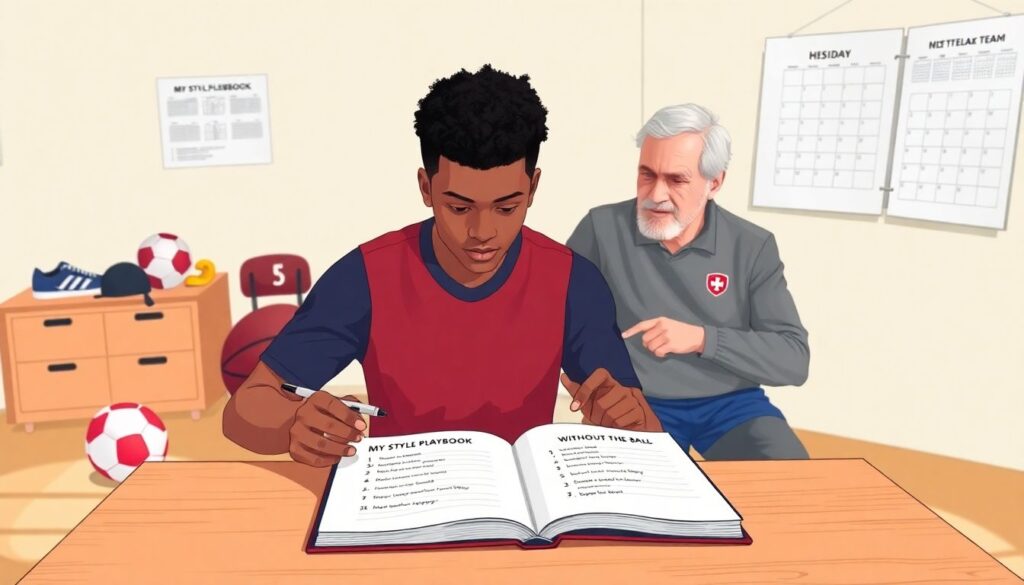
Write down two things you do with the ball and two without the ball that define your style. Review them every month with your mentor and adjust. Over time, you create your own mini‑playbook that travels with you from team to team.
Courses, platforms and resources that actually help
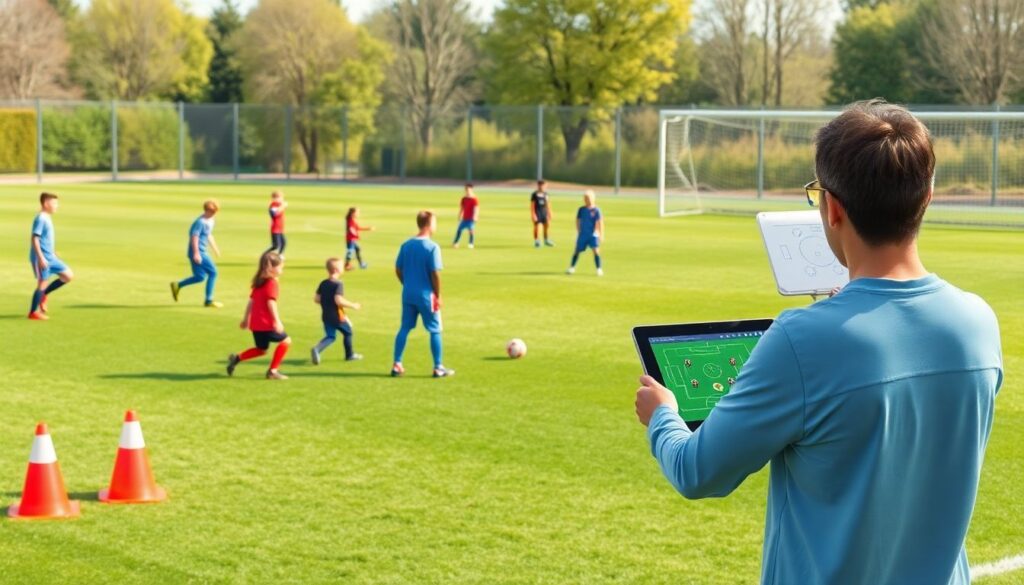
Theory only works when it lands on the pitch, so choose learning tools that connect concepts to real game footage. A good curso tático para treinadores de futebol de base should show youth‑level examples, not just Champions League clips, and should include tasks you can test with your team on the next training day. For players and parents, a plataforma de mentoria esportiva para jovens atletas offers a structured path: video breakdowns by position, individual feedback, and challenges like “find three moments you could have delayed instead of tackling” in your last game. Combined with your club training, this creates a dual‑track development: collective model during the week, individual refinement with your mentor on your own time. That blend is often what separates the kid who understands only his current team’s patterns from the one who can adapt tactically anywhere.
If your club doesn’t have access to such tools yet, you can still leverage free match analysis on the internet, but filter ruthlessly. Look for content that explains why decisions are made, not just highlights “beautiful” plays. Try to pause videos and predict the next action before it happens; then compare with reality. This simple habit trains your tactical anticipation far more than passively watching games.
Turning common errors into your competitive advantage
Most youth teams repeat the same tactical mistakes year after year. If you and your mentor decide to systematically attack those weaknesses—positioning, compactness, decision‑making under pressure—you don’t just “fix errors”; you build a differential. While others rely on physical growth spurts, you’re quietly building game intelligence that never disappears.