
Modern football analytics combines tracking data, event data and machine learning to support recruitment, match strategy and medical decisions. Clubs move from intuition-driven choices to testable hypotheses, reproducible metrics and clear visual reporting. Success depends less on exotic algorithms and more on data quality, workflow integration and coaching buy‑in.
Core trends to grasp
- Growing use of optical and wearable tracking to model team structure, space control and off-ball movement.
- Machine learning models supporting player profiling, scouting and squad planning rather than replacing human judgment.
- Real-time and near real-time event analytics informing in-game tactical adjustments.
- Predictive risk scores supporting injury prevention and load management decisions.
- Shift from raw stats to tailored dashboards, clips and visual stories usable by coaches and players.
- More robust data engineering, validation and governance to industrialise analytics across the club.
Advanced tracking data: from capture to tactical insights
Advanced tracking data captures the x,y (and sometimes z) position of every player and the ball several times per second. In professional football this usually comes from optical camera systems or wearable GPS/IMU devices, integrated into specialised software análisis de datos fútbol profesional used by analysts and performance staff.
The key difference from classic event data is coverage of off-ball behaviour. Tracking allows you to measure shape compactness, pressing intensity, line height, pitch control, and how space opens or closes over time. This underpins modern tactical analysis, especially for out-of-possession and transition phases that are hard to quantify otherwise.
Typical tracking-derived metrics include distances between lines, horizontal and vertical team stretch, speed of defensive shifts, offering lanes, and proximity networks between players. Combined with event data, these metrics help evaluate whether a tactical idea (for example, higher pressing or narrower block) is actually executed and what it costs in physical terms.
For Spanish clubs, the practical challenge is not only capturing data but orchestrating it with existing herramientas de análisis de rendimiento futbolístico, video platforms and medical systems so that insights arrive in time for coaches and are consistent across competitions and stadiums.
Machine learning for player profiling and recruitment
Machine learning in player recruitment focuses on learning patterns from historical data to forecast how a player might fit a role, league or tactical style. It is especially valuable when combined with servicios de análisis avanzado de datos para scouting futbolístico that standardise data across competitions.
- Feature engineering: Transform raw tracking and event data into role-relevant metrics (for example, progression under pressure, press resistance, defensive contribution in high zones) adjusted for team style and league context.
- Player role clustering: Use clustering algorithms to group players into data-driven roles, complementing traditional positional labels (for example, deep playmaker, attacking wing-back, box-defending centre-back).
- Similarity search: Compute distance between players in the engineered feature space to find replacements, backups or undervalued profiles with similar contributions.
- Outcome prediction: Train models to estimate probabilities of outcomes such as adaptation success, contribution to expected goals for/against, or resale potential, using past transfers as training data.
- League and style translation: Adjust metrics using league strength, tempo and tactical style so that a player in a lower league can be fairly compared to targets in La Liga or Segunda.
- Uncertainty estimation: Quantify confidence intervals and scenario ranges so decision-makers understand risk, not just point predictions.
Mini-scenarios grounds this mechanics:
- A mid-table Spanish club uses league-adjusted similarity search to identify affordable full-backs with high crossing volume and recovery sprints, matching the coach’s wide attacking style.
- A data department collaborates with consultoría big data para clubes de fútbol to cluster midfielders into style groups, then shortlists targets whose on-ball progression and off-ball work rate fit the club’s pressing model.
Event-level analytics: shaping in-game strategy

Event-level analytics describes every on-ball action: passes, shots, carries, duels, pressures and more. Combined with timing and location, this data supports a range of in-game and matchday decisions for coaches and analysts.
- Pre-match opponent analysis: Identify common patterns such as build-up preferences, pressing triggers, set-piece routines and crossing zones. This informs training micro-cycles and specific game plans.
- Live monitoring of game state: Track shot quality, territory, high-value turnovers and press success to decide whether to adjust block height, change wing focus or switch pivot structures during the match.
- Substitution optimisation: Combine physical indicators (where available) with involvement metrics (pressing volume, progressive receptions, entries into key zones) to time substitutions and adjust roles.
- Set-piece refinement: Evaluate success rates of routines by zone, run patterns and blocker arrangements; iterate designs between matches based on measurable outcomes.
- Post-match feedback loops: Visualise key sequences with overlaid data on video so players can connect numbers with decisions, particularly in transition moments and rest-defence situations.
- Benchmarking tactical experiments: When trying a new structure (for example, back three in possession), compare event-based KPIs before and after to assess impact beyond final scorelines.
Predictive models for injury prevention and load management
Predictive models for injury risk and load management combine external load (distances, accelerations, impacts), internal load (heart rate, wellness metrics) and contextual factors (travel, schedule congestion, playing surface). The goal is not to eliminate injuries but to inform better workload distribution and return-to-play decisions.
Benefits of predictive injury and load models
- Early warning signals for players showing unusual spikes or drops in key workload indicators, allowing micro-adjustments instead of drastic interventions.
- More objective support for medical and coaching discussions about training volume, intensity and rotation across congested fixtures.
- Structured monitoring of chronic workload trends, making it easier to evidence when cumulative risk is rising even without overt symptoms.
- Better planning of individualisation sessions, recovery modalities and gym work based on data-informed risk profiles.
- Feedback to technical staff on the physical cost of different tactical choices (for example, aggressive high press versus medium block).
Limitations and typical pitfalls

- Overconfidence in model precision, ignoring that injuries are multifactorial and partly random; probability is guidance, not certainty.
- Poor data quality or inconsistent collection across training, friendlies and competitive matches leading to misleading risk scores.
- Ignoring individual injury history, biomechanics and psychological factors that are hard to fully capture in numerical form.
- Lack of transparency in complex models, making it difficult for medical and performance staff to trust or challenge outputs.
- Using models as rigid rules (automatic rest decisions) instead of as structured input to expert multidisciplinary judgment.
Communicating analytics: dashboards, visual narratives and coaching adoption
Communication is often the difference between useful analytics and ignored work. Even the best modelos built on advanced datos y estadísticas can fail if they are not presented in coach-friendly formats using clear narratives and aligned with the team’s tactical language.
- Myth: more charts means more value. Dense dashboards can overwhelm coaches. Focus on three to five core views aligned to the game model and questions staff actually ask.
- Myth: coaches should adapt to analyst language. Adoption improves when metrics are framed in existing terminology (for example, rest-defence, half-spaces, compactness), not in abstract statistical terms.
- Error: separating video and data workflows. When platforms de datos y estadísticas para equipos de fútbol are not integrated with video, players struggle to connect metrics with concrete decisions they made.
- Error: changing metrics every season. Constantly redefined KPIs weaken trust. Maintain a stable core set, adding experiments only when needed and clearly labelled.
- Myth: automation replaces conversations. Automated reports are useful, but key insights usually emerge in collaborative review sessions where analysts, coaches and medical staff interpret patterns together.
Productionizing analytics: data pipelines, validation and governance
Productionizing analytics means turning ad-hoc analyses into reliable, repeatable workflows. Instead of manual exports before each match, clubs invest in pipelines that ingest data from tracking providers, event feeds and internal systems, validate it and deliver consistent outputs to reporting tools and coaching staff.
A minimal pipeline might automatically fetch event data after matches, standardise formats, run feature engineering scripts and refresh dashboards overnight. Governance adds documented definitions of metrics, access rules and quality checks so every department knows how numbers are created and can rely on them during high-pressure decision windows.
// Simplified pseudocode for a nightly post-match pipeline
load_raw_events()
events = standardise_schema(raw_events)
features = build_team_player_features(events)
validate(features)
publish_to_dashboard(features, destination="first_team_match_report")
Quick implementation suggestions for club practitioners
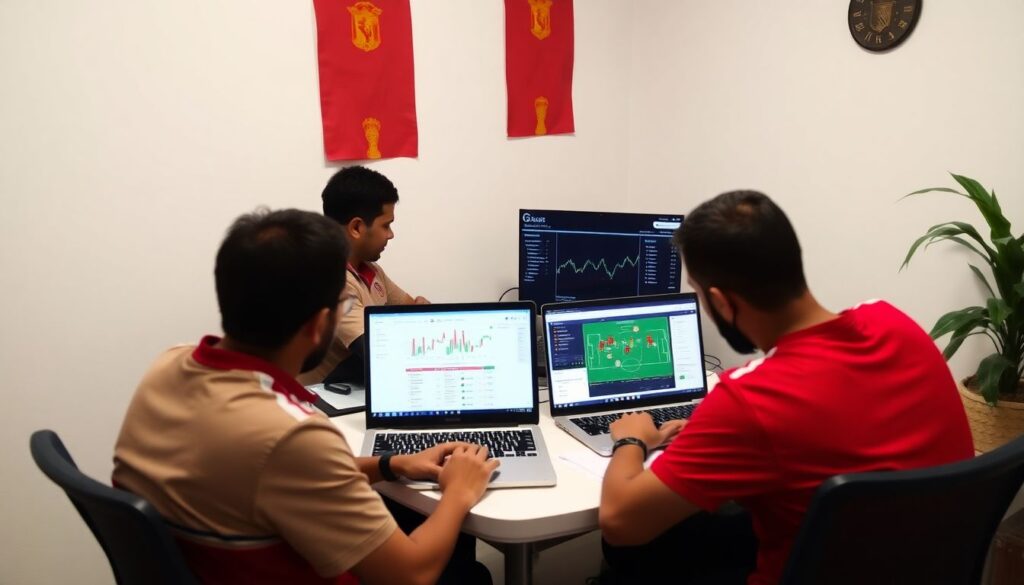
Clubs in Spain do not need huge budgets to start. Focus on a narrow scope, deliver quick wins and then expand. The goal is to connect data efforts directly to on-pitch or financial outcomes, not to mirror the biggest European clubs from day one.
- Define one priority question per department: For example, coaching (how effective is our press?), scouting (which profiles best fit our full-back role?), medical (which players accumulate risky workloads?). Build only what serves these questions.
- Standardise a small core of KPIs: Agree on a concise list for match analysis and training, then use the same definitions in all reports, meetings and debriefs.
- Leverage existing tools first: Many video and data systems already used in La Liga and Segunda include basic analytics; combine them with lightweight scripts before investing in heavier software análisis de datos fútbol profesional.
- Experiment with simple models: Before advanced machine learning, start with baselines like rolling averages or simple thresholds for workloads and pressing metrics to build trust and routines.
- Partner selectively: When working with consultoría big data para clubes de fútbol or external servicios de análisis avanzado de datos para scouting futbolístico, insist on transparent methods and knowledge transfer to internal staff.
- Iterate with coaches: After each cycle, ask staff which metrics and views they actually used; remove unused ones and refine the rest for clarity and speed.
Common practitioner clarifications
How is tracking data different from event data in practical terms?
Tracking data captures continuous movement of all players and the ball, including off-ball actions, while event data records discrete on-ball events like passes and shots. In practice, tracking is better for team structure and pressing analysis; event data is better for play-by-play and outcome evaluation.
Do small clubs really need machine learning for recruitment?
No. Smaller clubs can gain a lot from simple role definitions, consistent KPIs and structured video review. Machine learning adds value once data is standardised and scouting processes are stable; otherwise it risks adding noise rather than clarity.
Can in-game analytics be done without real-time tracking feeds?
Yes, to an extent. Many teams rely on live event feeds, simple hand-coded stats and clear pre-defined triggers to guide adjustments. Real-time tracking adds depth but is not mandatory for basic in-game decision support.
How reliable are injury prediction models for day-to-day decisions?
They are useful for spotting unusual patterns and grouping risk factors, but they cannot predict specific injuries. Treat outputs as an extra opinion in multidisciplinary meetings, not as an automatic rule for resting or playing a footballer.
What is the minimum data setup for a serious analytics programme?
At minimum: consistent event data for all matches, integrated video, clear metric definitions and a basic reporting workflow for coaches. Tracking data, advanced platforms de datos y estadísticas para equipos de fútbol and custom tooling can come later.
How do we avoid dashboards that coaches ignore?
Co-design them with the staff, start with their key questions, limit views to essential metrics and always connect numbers to clips. Regular feedback sessions help remove clutter and refine content to match the coaching language.
When is it worth building internal tools instead of buying existing ones?
Internal tools make sense when your questions or workflows are clearly different from what commercial herramientas de análisis de rendimiento futbolístico offer, and when you have staff to maintain them. Otherwise, adapt existing platforms and focus internal efforts on bespoke analysis and communication.