
Emotional intelligence sounds fancy, but on the pitch it’s actually very simple: it’s your ability to stay clear-headed when your heart is racing, your legs are heavy and the crowd is screaming. If you don’t read your own emotions and respond to them with strategy, they start to play instead of you. That’s when the easy pass goes out of bounds, the sure goal becomes a shank, and one bad call turns into a red card. Let’s break down how to handle nervousness, fear and euphoria in a way that any player, coach or parent can actually use in real games.
—
Why emotional intelligence is a performance skill, not a “soft” topic
How emotions change decisions, reactions and body language
Inside the game, your brain is constantly choosing between “survival mode” and “performance mode”. Survival mode is fueled by fear, anger and panic; performance mode is guided by awareness, focus and emotional control. When you don’t manage this switch, your body overreacts: heart rate spikes, breathing gets shallow, muscles stiffen. That’s when your first touch gets heavy, timing is late and you avoid the ball instead of demanding it. Emotional intelligence is the skill that lets you notice this shift in real time and bring your system back to performance mode before damage is done, instead of waking up after the match wondering “what happened to me out there?”.
Case: The striker who disappeared every time the stadium got loud
A top-division striker in South America had great numbers in training, but during TV games he barely touched the ball in the first 30 minutes. GPS and match data showed he was literally hiding behind defenders, not offering for the pass. After a few sessions we discovered a pattern: as soon as he heard the crowd roar, he had a subconscious flashback to a missed penalty in his teens and went straight to survival mode. We worked on emotional labeling and breathing routines before kick-off, plus a simple cue word (“show”) to remind him to step toward the ball when he felt like hiding. Within seven games his early-match touches doubled, and the staff didn’t change his tactics at all—only his emotional management.
—
Comparing different approaches to emotional intelligence on the pitch
Classic sports psychology vs modern mental coaching
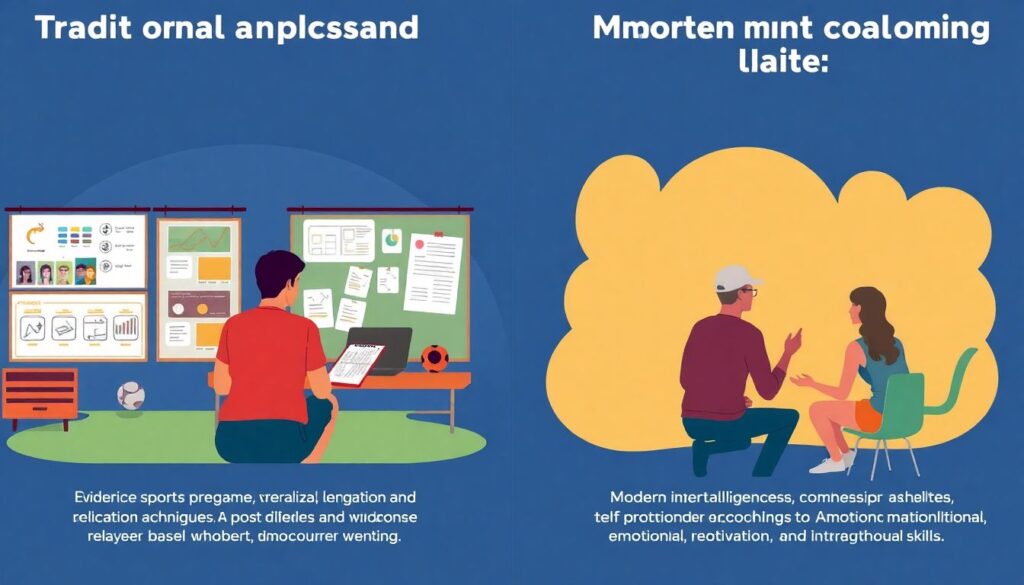
Traditional sports psychology tends to focus on pre-game preparation, visualization, relaxation and post-game debriefing. It’s structured, evidence-based and especially strong for players who like frameworks and “homework”. Modern mental coaching, including coaching em inteligência emocional para esportistas, usually looks broader: relationships in the locker room, identity off the field, communication with staff and family. It’s more conversational and flexible, which works very well for players who resist anything that sounds too “clinical”. In practice, the best programs mix both: the rigor of psychology (tested tools, measurements) with the flexibility of coaching (real-life context, everyday language, feedback loops built around training and matches).
Individual sessions, group work and online courses
One-on-one work allows deep dives into personal fears, family history and specific triggers, but it’s time-consuming and expensive. Group sessions build shared vocabulary for emotions (“we’re tense”, “we’re drifting”) and trust inside the squad, yet some players will never open up fully in front of teammates. Online formats—like a curso de inteligência emocional para jogadores de futebol—can deliver structured content to a whole squad at once, mixing videos, exercises and match-day routines. The trade-off is lower personalization, but it dramatically raises basic awareness. The most effective clubs usually combine short group inputs, a digital program everyone must complete, and targeted individual follow-ups for players who show clear emotional bottlenecks.
—
Technologies and tools: pros and cons inside real football environments
Apps, wearables and biofeedback: what actually helps

Over the last few years, clubs have begun using breathing apps, HRV (heart rate variability) tracking and even portable neurofeedback headsets to sharpen emotional control. The upside: these technologies give players concrete feedback. They can see on a screen how five minutes of slow breathing drops heart rate and increases calm readiness. This turns abstract advice into something measurable and competitive. On the downside, not every environment is ready for gadgets on top of all the existing GPS, wellness questionnaires and video meetings. Too many tools quickly become noise, and some athletes feel “over-monitored”, which ironically increases anxiety instead of reducing it. The key is to choose one or two tools that genuinely fit the culture and routines of the team.
Pros and cons of structured mental training programs
When a staff introduces structured treinamento mental para atletas de futebol, performance often stabilizes: fewer emotional collapses after conceding, more consistency under pressure. A big benefit is creating shared routines—breathing at set times, specific reset rituals after mistakes, standard language from coaches on the bench. The main drawback is resistance: players might see it as “extra work” on top of physical and tactical overload, especially if it’s badly explained or feels disconnected from the game model. If emotional work doesn’t clearly link to winning more duels, scoring more chances or avoiding stupid cards, buy-in drops fast. That’s why integrating short exercises directly into warm-ups and small-sided games is usually more effective than long classroom sessions.
—
Practical methods to control nervousness, fear and euphoria
How to handle nerves: pre-game routines that work on real pitches
Every player asks at some point como controlar o nervosismo antes do jogo, but few have a clear, repeatable protocol. One effective approach is a three-phase routine: first, “download” your thoughts by writing or voicing what worries you (opponent’s speed, scouts in the stands, family issues). Second, regulate physiology through 2–3 cycles of slow exhale-focused breathing (for example, inhale 4 seconds, exhale 8). Third, step into “action mode” by previewing only the first three actions you want in the match—pressing trigger, support angle, safe pass. This shrinks the game from 90 minutes of unknowns into a manageable opening scenario. Players who apply this consistently report that the first whistle no longer feels like a cliff edge but like the next step of a familiar script.
Techniques to tame fear and channel euphoria
Fear and euphoria look opposite, but on the body level they’re both high arousal states. That’s why técnicas para controlar medo e ansiedade no esporte usually start the same way: recognize your emotional state quickly, name it in simple words (“I’m scared”, “I’m too hyped”), then adjust your breathing and body posture. For fear, the priority is expanding your field of vision: lift your head, widen your gaze, take one deeper inhale to “open up” space again. For euphoria—after a goal, a big tackle, crowd going wild—the challenge is not losing discipline. A useful in-game ritual is “celebrate, reset, refocus”: allow yourself a 5-second celebration, then physically turn your body toward your own goal and take one reset breath while identifying the next tactical job. This keeps joy but prevents tactical chaos.
—
Case studies from real practice
The center-back who stopped diving into reckless tackles
In a European academy, a talented 18-year-old center-back had a pattern: after a single lost duel, he started over-committing, diving into tackles to “make up for it”. Cards piled up, and coaches tagged him as “undisciplined”. In individual sessions we mapped his emotional chain: mistake → inner narrative (“I’m letting everyone down”) → anger → impulsive tackle. We designed a simple in-game checkpoint: every time he felt that hot “rush” in his chest, he had to physically step back two steps instead of stepping forward. That physical anchor gave him a split-second to choose positioning over aggression. Over the next season, his yellow cards dropped by a third while his duels won actually went up, showing that emotional control sharpened, not softened, his defensive edge.
The playmaker who turned anxiety into a focus weapon
A creative midfielder playing in a Brazilian first division struggled in big derbies: he avoided risky passes, choosing only backwards or sideways options. He described his mind as “noisy” and full of “what if I lose it?” moments. We combined brief coaching sessions with a micro “pre-pass routine”: before receiving, he’d exhale, quickly scan twice (pressure, best option), then commit fully to the chosen pass without second-guessing mid-action. We also integrated coaching em inteligência emocional para esportistas elements, exploring how his fear of criticism from family and media shaped his risk tolerance. Within months, video analysis showed not only more line-breaking passes but also a calmer reaction to turnovers—he sprinted to recover instead of freezing in frustration.
—
Choosing the right emotional intelligence approach for your context
For players, coaches and parents: where to start
If you’re a player, start by tracking your emotional patterns across several games: when do you tighten up, when do you overheat, when do you disappear? From there, pick just one tool—like a breathing pattern or a reset word—and test it in friendlies and training games. Coaches should embed emotional drills into sessions instead of bolting them on: for example, set up a small-sided game where a team gets bonus points for how quickly they reset after conceding. Parents of young athletes can help by discussing feelings around matches in neutral language, avoiding labeling kids as “nervous” or “weak” and focusing instead on behaviors they can train, just like first touch or speed.
How clubs and academies can design sustainable programs
At club level, the smart move is to start small and consistent. Choose a basic framework, perhaps supported by an online curso de inteligência emocional para jogadores de futebol, and connect it clearly to performance metrics the squad already cares about: fewer red cards, better last-15-minutes stats, more stable results after conceding first. Add targeted treinamento mental para atletas de futebol for key positions—keepers, center-backs, strikers—who face specific emotional loads. Avoid over-promising; present emotional work not as a magic cure but as another performance tool to master. Most resistance disappears when players see that what they practice on the mental side shows up directly in duels, passes and decisions under pressure.
—
Trends and innovations in emotional intelligence for football by 2026
Integrated staff roles and data-informed emotional work
Looking toward 2026, the trend is clear: emotional intelligence will stop being a “nice extra” and become fully integrated into high-performance structures. Many clubs are already creating hybrid roles where performance psychologists, data analysts and assistant coaches share information. Match data like decision-making under fatigue, reactions after conceding or body language indicators are being cross-referenced with mental training logs. Instead of general workshops, players will receive tailored micro-interventions based on how they emotionally respond to specific match contexts, such as penalties, crowd pressure or VAR decisions, making mental training as individualized as physical periodization.
Hybrid learning, AI support and everyday practice
Another strong trend is hybrid learning: short in-person sessions supported by digital platforms that deliver weekly micro-lessons, guided audios and in-game cues to players’ phones. AI-driven tools will likely help coaches detect patterns in match behavior that signal emotional overload—repeated long clearances instead of building from the back, avoidance of the ball after a mistake, or sudden spikes in fouls committed. The challenge will be using this information ethically and constructively, not to label or punish players but to offer precise técnicas para controlar medo e ansiedade no esporte tailored to their context. The teams that treat emotional intelligence as an everyday training content, not a crisis tool, will be the ones turning tight games in their favor when tension is highest.